 blog
Advanced Off Leash Dog Training Programs: 2026 Guide
Last Updated: October 24, 2026
Quick Summary
Advanced off leash dog training programs teach a dog to hold commands reliably around real distractions, not just in a quiet training center. The goal is a dog that comes when called, walks at heel, and stays put while other dogs, people, and wildlife move nearby. Programs that skip generalization produce dogs that perform only where they were trained.
- Board-and-train moves fastest because the trainer controls every repetition, but you must learn handling afterward.
- A long line is a lightweight 15- to 30-foot lead used to safely test recall before trusting a dog in the open.
- Never call a dog to scold it, because the recall cue must never predict something unpleasant.
- For reactive dogs, off leash work only becomes safe after the dog stays under threshold around triggers on leash.
- A dog is generally ready for advanced off-leash work when it holds sit, down, stay, recall, and heel on a standard leash around mild distractions.
Table of Contents
- What Advanced Off Leash Training Programs Actually Deliver
- Program Formats Compared: Board-and-Train, Day Training, and Private Lessons
- Dog Recall Training: The Skill That Makes Off Leash Freedom Possible
- Long-Line Dog Training: The Bridge From Leash to Off Leash
- Dog Training Program Cost: What Drives the Price and What You Get
- Dog Training for Reactive Dogs: Can Off Leash Reliability Be Safe?
- How to Choose an Advanced Program and Keep the Results
- Frequently Asked Questions
What Advanced Off Leash Training Programs Actually Deliver
Advanced off leash dog training programs teach a dog to hold commands reliably around real distractions, not just in a quiet training center.
That distinction matters. A dog that bolts toward a road is not being stubborn; it has never been proofed against real-world pressure. Structured programs build that proofing in layers.
What you should expect from a serious advanced program:
- Generalization: the same command works in a park, a parking lot, and your driveway
- Distance and duration: stays and recalls hold at 20, 30, or 50 feet
- Distraction proofing: dogs, squirrels, cyclists, and noise
- Handler skill: you learn to read and redirect your dog
Programs that skip generalization produce dogs that perform only where they were trained.
Program Formats Compared: Board-and-Train, Day Training, and Private Lessons
Three formats dominate advanced training, and they differ mostly in who does the repetition. Board-and-train keeps the dog with a trainer for weeks. Day training takes the dog for structured sessions and returns it each evening. Private lessons put you and your dog in front of a trainer together.
| Format | Who does the work | Best for | Main trade-off |
|---|---|---|---|
| Board-and-train | Trainer, full-time | Fast progress, busy owners | You must learn handling afterward |
| Day training | Trainer, part-time | Owners who want daily structure | Slower than boarding |
| Private lessons | You, coached | Owners who want full control | More homework between sessions |
Board-and-train moves fastest because the trainer controls every repetition. The catch is that the dog may obey the trainer and ignore you. Any reputable program builds handler lessons into the handoff.
Day training suits owners who can drop off and pick up but want the dog home each night. Private lessons are the best fit if you want to understand every step yourself.
You can review training packages to compare formats side by side before deciding.
Dog Recall Training: The Skill That Makes Off Leash Freedom Possible
Recall is the single command that makes off leash freedom defensible. A dog that will not come when called should not be off leash, no matter how well it heels.
Reliable recall rests on three habits. First, the cue must never predict something unpleasant, so never call a dog to scold it. Second, every recall should be rewarded, at least some of the time, with something the dog values. Third, recall must be rehearsed at increasing distances and distractions, not just in the backyard.
A practical sequence for recall training often includes:
- Rewarding the dog for checking in unprompted
- Practicing recall on a 6-foot leash with low distraction
- Adding distance indoors, then in a fenced yard
- Introducing mild distractions, then moderate ones
- Moving to open ground on a long line
The American Kennel Club's guidance on recall training reinforces that consistency and reward timing matter more than repetition volume.
Many owners find that recall is where advanced off leash dog training programs earn their keep. The command is simple; the proofing is not.
Long-Line Dog Training: The Bridge From Leash to Off Leash
Long-line dog training is the middle step between a short leash and full off leash work.
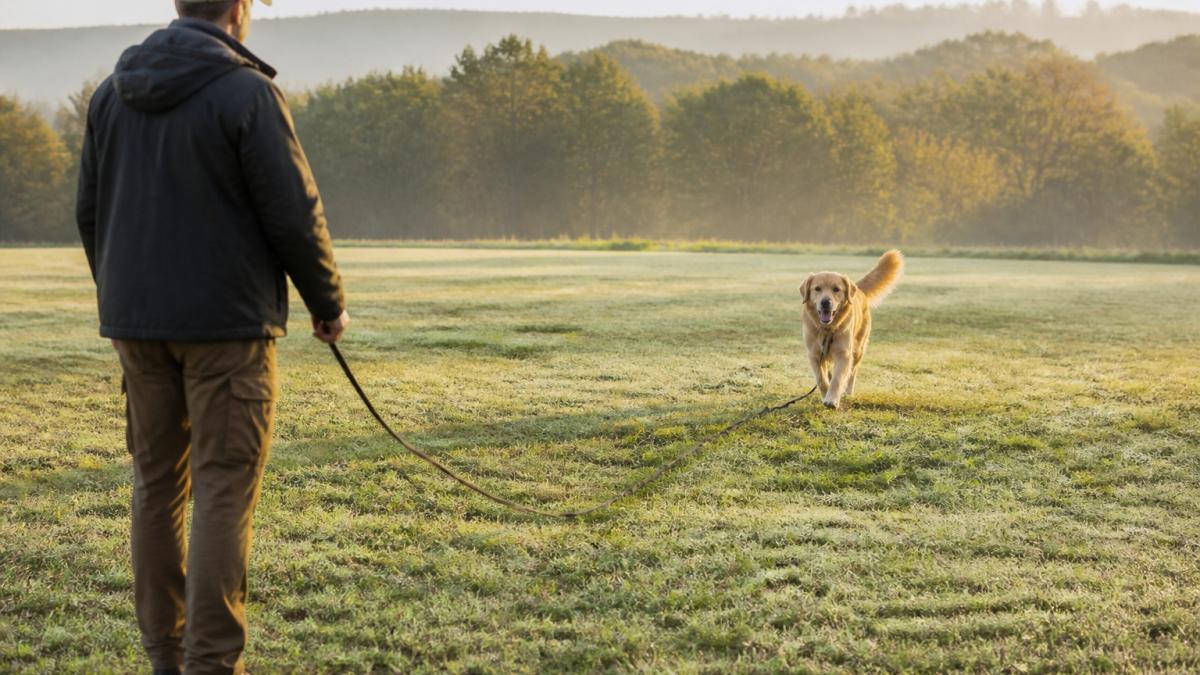
The long line teaches the dog that distance is normal and that coming back is always rewarded.
Start with a 15-foot line in a low-distraction area. Practice recall, stays, and heel transitions. Increase to 30 feet only when the dog responds reliably at the shorter distance.
Dog Training Program Cost: What Drives the Price and What You Get
Dog training program cost is not a single flat rate. It is a stack of line items, format, duration, behavior complexity, handler instruction, and follow-up, and the headline price usually hides at least one of them.
A common pattern in the market is that board-and-train carries the highest sticker price because the trainer controls every repetition for weeks, day training sits in the middle because the trainer does part-time work, and private lessons have the lowest per-session price but the highest owner time cost.
What moves the price, in rough order of impact:
- Format: board-and-train is the most labor-intensive and typically the most expensive; private lessons are the least expensive per session but require the most owner hours.
- Duration: a multi-week board-and-train costs more than a short day-training block; a year-long maintenance plan costs more than either.
- Behavior complexity: aggression rehabilitation and anxiety training take longer than standard obedience and are usually priced separately or quoted after an assessment.
- Handler lessons: programs that include transfer sessions and owner coaching cost more up front but are cheaper over a year because results hold.
- Real-world field trips: programs that practice in parks, parking lots, and public spaces carry higher operating costs than facility-only programs.
- Follow-up support: included refreshers and check-ins are a real cost to the provider and a real value to you.
A practical way to compare quotes is to ask each provider for a written breakdown with five lines: number of training sessions, number of handler sessions, total duration in weeks, locations used, and what happens if progress stalls. Two quotes with the same headline number can differ by thousands of dollars in what they deliver once those five lines are on paper.
Watch for three pricing traps. First, a low headline price with no handler lessons usually costs more over a year because you pay again to fix the handoff. Second, a per-session rate that excludes field trips hides the most valuable part of advanced work. Third, a quote that promises a fixed outcome before assessing the dog is guessing, and you will likely pay for the guess.
Pricing depends on the specific needs of each dog, as a puppy with a clean slate may require less time than a rescue dog with reactivity. Ask any provider for a detailed breakdown and compare like for like.
Dog Training for Reactive Dogs: Can Off Leash Reliability Be Safe?
Off leash reliability for a reactive dog is possible, but it should never be the first goal. Reactivity means the dog overreacts to triggers like other dogs, strangers, or moving vehicles.
The order matters:
- Identify the dog's triggers and the distance at which it stays calm
- Build obedience and focus at that distance
- Gradually reduce distance as the dog holds composure
- Add long-line work in controlled settings
- Only then consider off leash in low-risk areas
Aggression rehabilitation and anxiety training sit at the harder end of this work and take longer than standard obedience. Some dogs should never be off leash in public, and a good trainer will say so plainly. Safety for the dog, the handler, and the public comes before convenience.
How to Choose an Advanced Program and Keep the Results
Choosing an advanced program is a matching problem, not a shopping problem.
Start with readiness.
Then judge the program on measurable outcomes, not adjectives.
Welfare and methods matter as much as outcomes.
Safety and legal responsibilities belong in the decision. Off-leash access is governed locally, and leash laws vary by jurisdiction, so confirm where off-leash is legal before practicing.
Use this checklist before you commit:
- Does the trainer assess your dog against concrete readiness benchmarks before quoting?
- Are handler lessons and transfer sessions included, or is training done only to the dog?
- Does the program define reliability by distance, duration, and distraction level?
- Will reliability be tested in more than one location and with more than one handler?
- Are methods welfare-first and free of fear or pain, with a stated plan for over-threshold moments?
- Is there a written plan with session count, duration, and locations?
- Does the program cover local leash law, safe practice areas, and recall-failure risk?
- Is there follow-up support and a maintenance plan after the program ends?
Maintenance is the other half of the decision.
If you have questions about the process, frequently asked questions often cover what owners ask most before starting. To confirm service availability, check the service area. And if you are weighing whether advanced training is worth the investment, information on why training matters can explain the long-term payoff.
Frequently Asked Questions
What skills should a dog know before starting off leash training?
A dog should hold a reliable sit, down, and stay at a distance, walk on a loose leash without pulling, and come when called in a low-distraction room before off leash work begins. Most advanced programs also expect the dog to handle name recognition and a release cue. If your dog still breaks a stay when the doorbell rings, that gap gets fixed first. Ask any provider what prerequisite skills they screen for, because skipping this step is the most common reason off leash training fails.
How long does advanced off leash dog training take?
Timelines vary by format and dog. Private lesson packages often run six to eight weeks with weekly sessions, while board-and-train programs may compress the teaching phase into two to four weeks followed by owner handoff lessons. A year-long program exists for dogs needing ongoing proofing in new environments. Dogs with a history of reactivity or aggression usually need more time. Ask for a written schedule with milestones rather than a single completion date, and confirm how many sessions are included after the dog comes home.
Can reactive or aggressive dogs learn off leash skills?
Some can, with conditions. Dog training for reactive dogs starts with behavior modification at a distance from triggers, then adds duration and proximity as the dog stays under threshold. Off leash freedom is only appropriate once the dog shows consistent, calm responses around other dogs and people in controlled setups. Many trainers recommend keeping a long line or leash on reactive dogs in public indefinitely. Ask whether the program includes a realistic assessment of your dog's limits and whether it teaches you to read stress signals.
How much do professional off leash dog training programs cost?
Dog training program cost depends on format, duration, and how much one-on-one time is included. Board-and-train typically costs the most because it bundles daily training with boarding. Day training sits in the middle, and private lesson packages are usually priced per session or in bundles. Pricing varies by provider and location, so request an itemized quote that lists the number of sessions, handoff lessons, and any follow-up support. Compare total cost against what is included, not the headline number.
Advanced off leash training only pays off when the dog, the trainer, and the owner all do their part. If you are ready to build real-world reliability with a program tailored to your dog, Voca Springs Dog Training offers obedience and behavior modification built around your goals, with a focus on the owner-dog bond and support that lasts past the last session. Get started with Voca Springs Dog Training and give your dog the freedom that comes from genuine, tested control.