 how-to
What Advanced Commands Should Every Family Dog Know?
Last Updated: October 26, 2026
Quick Summary
The advanced commands that matter most for a family dog are recall, place, leave it, and a reliable stay. Each one protects your dog in a real moment, like a gate left open, food dropped on the floor, or a guest at the door. Teach them in this order and build distance and distraction slowly.
- Your dog needs name response, a marker word or clicker, and a few minutes of focus before advanced work begins.
- Never skip the long line when building recall, so mistakes stay safe.
- Raise only one of the three Ds at a time: distance, duration, or distraction.
- Ten minutes a day, split into two five-minute blocks, beats one long weekend session.
- If your dog fails more than about two out of ten repetitions, you raised difficulty too fast.
Table of Contents
- Which Advanced Commands Actually Matter for a Family Dog?
- Dog Recall Training: The Command That Keeps Your Dog Safe
- How to Teach a Dog Place Command for Calm Households
- Dog Leave It Command Training: Impulse Control That Protects
- Proofing Dog Commands Around Distractions
- A Step-by-Step Path From Basic to Advanced Commands
- Training Plans for Busy Families and Kids
- Measuring Progress and Fixing Setbacks
- Frequently Asked Questions
Which Advanced Commands Actually Matter for a Family Dog?
Advanced commands are the cues that keep a family dog safe, calm, and easy to live with once basic obedience is solid. At Voca Springs Dog Training, we focus on a short list that solves real household problems, not a long list that impresses judges.
Most owners try to teach too many cues at once. That slows learning. A tighter list, practiced well, builds faster reliability.
The Commands Worth Teaching First
Start with the four that carry the most safety and calm:
- Recall ("come"): brings your dog back under real distraction.
- Place ("go to your mat"): gives your dog a settled spot during meals and visits.
- Leave it: stops your dog from grabbing food, trash, or hazards.
- Stay: holds your dog in position while you handle a door, leash, or child.
These four do more for daily life than a dozen party tricks. Teach them in this order and build distance and distraction slowly.
Prerequisites Before You Start
Your dog needs three basics before advanced work begins: name response, a marker word or clicker, and a few minutes of focus. If your dog cannot look at you on cue in the living room, advanced commands will stall.
Not sure whether your dog is ready? Our frequently asked questions cover prerequisites and how professional training works.
A common mistake is jumping to distance work before the dog can hold a cue for three seconds at home. Fix the foundation first. The advanced layer sits on top of it.
Dog Recall Training: The Command That Keeps Your Dog Safe
Recall is the single most important safety cue you can teach. A dog that comes when called avoids traffic, fights, and lost-dog risk. It is also the hardest cue to proof, because it competes with everything interesting in the world.
Build recall in stages:
- Practice indoors with no distraction and reward every response.
- Move to a fenced yard and add distance one step at a time.
- Add mild distraction, like a toy on the floor.
Building Recall From Leash to Open Space
Never skip the long line. It lets your dog practice coming while still attached, so mistakes stay safe. Reward with high-value food and praise every single time during this phase.
Watch out: calling your dog only to end the fun teaches a dog to avoid the cue. Call, reward, then release back to play.
How to Teach a Dog Place Command for Calm Households
Place gives your dog a job during the chaos of family life. The goal: your dog goes to a mat or bed and settles while you cook, eat, or answer the door.
Follow these steps:
- Put a mat on the floor and reward any interaction with it.
- Reward your dog for standing on the mat.
- Add the cue "place" as your dog steps on.
- Reward longer stays, one second at a time.
- Practice while you move around the room.
A dog with a solid place cue stops begging at the table and stops jumping on guests. That alone changes a household.
Dog Leave It Command Training: Impulse Control That Protects
Leave it teaches your dog to turn away from something tempting. It protects your dog from dropped medication, chicken bones, and trash on walks. It also builds impulse control that carries into every other cue.
Teach it in this order:
- Hold a treat in your closed fist. Reward your dog for backing off.
- Place a treat on the floor and cover it with your hand.
- Add the cue "leave it" once your dog reliably backs away.
Reward the choice to disengage, not just the absence of grabbing. A dog that gets paid for looking away will look away faster next time.
Proofing Dog Commands Around Distractions
Proofing means teaching your dog that a cue works everywhere, not just in the kitchen. A command your dog obeys only at home is not reliable. Real life happens at the park, on the sidewalk, and at the front door.
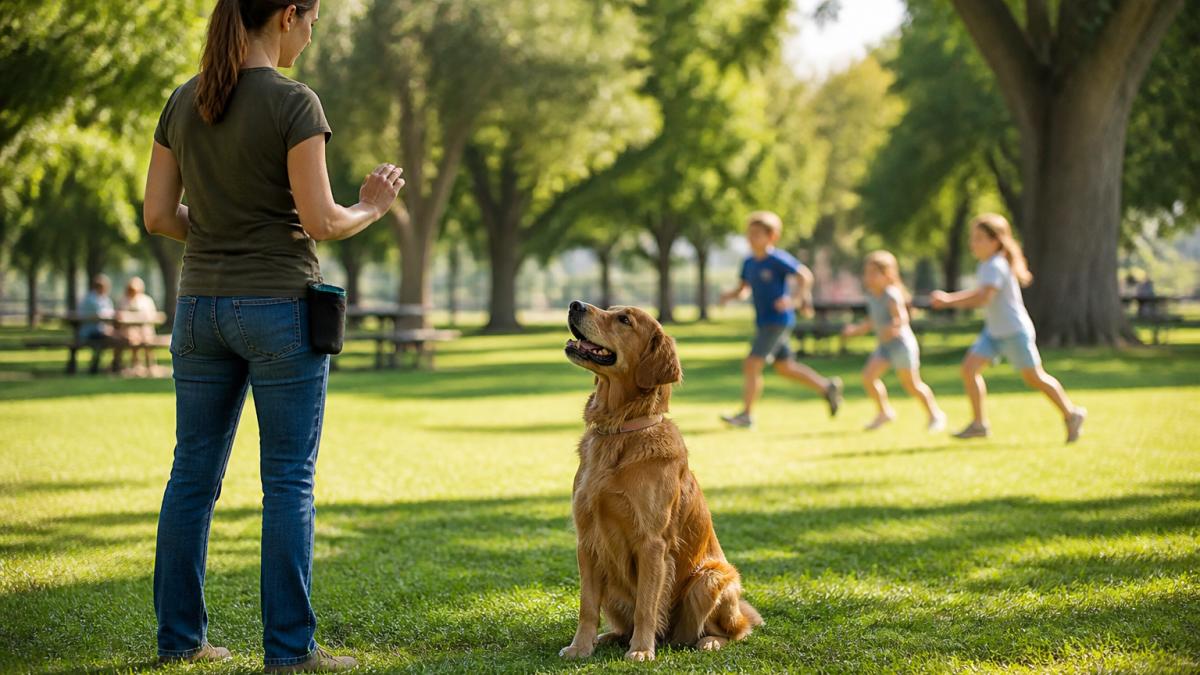
The Three Ds: Distance, Duration, Distraction
The three Ds are the dials you turn to make any cue harder. Increase one at a time, and drop back a level when your dog struggles.
| Dial | What It Means | How to Increase It |
|---|---|---|
| Distance | How far you are from the dog | Add one step at a time |
| Duration | How long the dog holds the cue | Add one second at a time |
| Distraction | How tempting the environment is | Add one mild distractor at a time |
A common mistake is raising all three dials at once. That sets the dog up to fail. Change one dial, repeat until solid, then change the next.
A Step-by-Step Path From Basic to Advanced Commands
Advanced work is a ladder, not a leap. The gap in most guides is that they list commands without saying what "ready for the next rung" actually looks like. Here is the path we use with family dogs, with a concrete pass criterion for each stage so you know when to move up and when to hold.
- Foundation (1-2 weeks): name response, a marker word ("yes") or clicker, and three seconds of eye contact. Pass when: your dog turns to their name eight out of ten tries in a quiet room and takes a treat gently from your hand.
- Basic cues (2-4 weeks): sit, down, and a five-second stay at home. Pass when: each cue works with one verbal cue and no lure in two different rooms.
- Single-cue reliability (2-3 weeks): each cue works in three rooms of the house, including the kitchen and front hallway. Pass when: success rate is roughly eight out of ten repetitions per room.
- Leash work (2-4 weeks): cues hold on a walk with mild distraction, a passing neighbor, a parked car, a leaf blowing. Pass when: your dog responds to sit and leave it on a loose leash before the distraction is within ten feet.
- Long line (3-6 weeks): recall and stay practice with distance on a 15- to 30-foot line in a fenced or open but safe area. Pass when: recall succeeds eight out of ten times at 20 feet with one mild distraction.
- Real-world proofing (ongoing): parks, sidewalks, front doors, pet-store entryways. Pass when: the cue holds in at least three new locations with different handlers in the family.
- Maintenance (forever): two to three short sessions per week, plus real-life rewards (a released "go sniff," a tossed treat, a game of tug) whenever your dog nails a cue in daily life.
Reward Timing at Every Stage
The mechanics matter more than the command list. Mark the exact behavior with your marker word the instant it happens, then deliver the treat within about one second. If you mark late, you reward the wrong thing, a dog who stood up before the treat arrived learns that standing up earns food. During the long-line and proofing stages, pay with higher-value food (small pieces of chicken or cheese) and pay every correct response, not every third one.
When to Hold a Rung
A common pattern is a dog who breezes through stages one to three and stalls at real-world proofing. That is normal, not stubbornness. If your dog fails more than about two out of ten repetitions, you raised difficulty too fast. Drop back one stage, rebuild for three or four sessions, and try again. Do not add a new command while an old one is shaky; a tight list practiced well beats a long list practiced poorly.
When you want structured help moving up the ladder, our training packages take dogs from basic to advanced commands with a clear plan.
Training Plans for Busy Families and Kids
Families do not need long sessions. They need short, repeatable ones with one person running the cue at a time. Ten minutes a day, split into two five-minute blocks, beats one long weekend session, and it fits around school runs, dinner, and bedtime.
One Cue, One Handler
The single biggest family-training mistake is everyone using a different word or hand signal for the same behavior. Pick one cue per behavior and post it where the family can see it: "come," "place," "leave it," "stay." One person gives the cue; everyone else stays quiet and does not repeat it. A dog hearing "come, come, come" from three people learns that the cue is background noise.
Age-Appropriate Roles for Kids
Children can be excellent trainers when the job matches their age and the adult stays within arm's reach.
- Ages 4-6: hold the treat, drop it on the mat, and cheer. They reward place and leave it; an adult gives the cue.
- Ages 7-9: give the cue for place and sit, with an adult standing beside them and a treat already in hand. Keep sessions to two or three repetitions.
- Ages 10-12: run a five-minute place or leave-it session with an adult in the room, and help log success rates.
Keep the rules simple and non-negotiable: no chasing the dog, no grabbing the collar to force a come, no repeating a cue more than once, and no training when the dog is tired, hot, or overexcited. If a child gets frustrated, the session ends, the dog should never learn that kids are unpredictable.
A Simple Weekly Plan
- Monday and Wednesday: recall practice on the long line (adult handler).
- Tuesday and Thursday: place and settle work during dinner prep, the dog earns the mat while the family cooks.
- Friday: leave-it repetitions with a dropped item (a dish towel, a toy) in the kitchen.
Shared Responsibilities
Assign one "lead trainer" per week so the cue and reward timing stay consistent, and have that person write the week's success rates in a shared note. Rotate the lead weekly so every adult and older child gets practice, and so the dog learns that the cue works no matter who says it.
Want to know who you would be working with? Read about our team before you book.
Measuring Progress and Fixing Setbacks
Track progress in a simple log: cue, location, distance, duration, distraction, and success rate. A dog that holds place for ten seconds in the kitchen but fails at the front door is not stubborn.
When a cue breaks down, drop back one level and rebuild. Setbacks usually mean you raised difficulty too fast.
If you wonder whether advanced commands are worth the effort for a family pet, our guide to why training matters explains the payoff in daily life.
Frequently Asked Questions
What advanced commands are most useful for family dogs?
The commands that pay off daily are a reliable recall, place, leave it, a solid stay with a release word, and a backup or move-out-of-the-way cue. These cover the situations families actually face: a door left open, food dropped on the floor, guests arriving, and tight spaces. Start with recall and leave it because they protect the dog, then add place and stay for calm household routines.
How long does it take to teach a dog advanced commands?
Timelines vary with the dog's age, history, and how often you practice. A dog with solid basics often shows reliable response to a new command in a few weeks of short daily sessions, but proofing around real distractions takes longer, often several months of consistent work. Short, frequent sessions of five to ten minutes beat one long weekly session. Progress depends more on repetition quality than on total time.
How do you teach a dog to come when called around distractions?
Build recall indoors first with high-value rewards, then practice in a fenced yard, then on a long line in new places. Add distractions one at a time, starting with mild ones like a familiar person nearby. Never call your dog to something unpleasant, such as ending play or a bath. Reward every successful recall generously, and use a long line so the dog cannot rehearse ignoring you.
Can kids in the family help with advanced command training?
Yes, with supervision and clear rules. Children can hold the leash in a fenced area, deliver treats after a correct response, and practice simple cues like place or sit. Keep sessions short and calm, and teach kids to avoid repeating a cue or grabbing the dog. Assign one adult as the main handler for recall so the cue stays consistent, and let children practice the easier commands first.
Advanced commands take patience, but the payoff is a dog you can trust in the moments that matter. If you want a clear plan and hands-on coaching, Voca Springs Dog Training offers obedience and behavior modification programs built around your household. We focus on strong owner-dog bonds, real-world proofing, and lasting results. Get started with Voca Springs Dog Training and build a dog you can rely on anywhere.