 how-to
Can Dog Training Fix Separation Anxiety? 7 Steps That Work
Last Updated: October 27, 2026
Quick Summary
Dog training can fix separation anxiety in most cases by using gradual desensitization, starting with absences measured in seconds and only adding time when your dog stays calm. Training cannot fix an underlying medical issue, so dogs that injure themselves or show no progress after four to six weeks of consistent work need a veterinary assessment.
- Keep every repetition below your dog's panic threshold so the door closing stops predicting a bad outcome.
- Run one or two sessions per day, 10 to 15 minutes each, repeating the same duration before changing anything.
- If panic occurs at any point, cut the duration by half and rebuild from there.
- Desensitize departure cues like keys and shoes by practicing them randomly with no exit attached.
- Get a veterinary assessment if your dog shows no measurable progress after four to six weeks of training.
Table of Contents
- Can Dog Training Fix Separation Anxiety?
- Signs of Separation Anxiety in Dogs
- How to Train a Dog to Be Alone
- Your Separation Anxiety Training Plan
- How Long Does Separation Anxiety Training Take?
- When Training Is Not Enough: Veterinary Assessment and Medication
- What to Do When Absences Cannot Be Avoided
- Building Your Dog's Alone-Time Skills with Voca Springs
- Frequently Asked Questions
Can Dog Training Fix Separation Anxiety?
This guide discusses dog training and separation anxiety.
What Training Can and Cannot Do
Threshold matters: it means the longest absence your dog can handle without panicking. Every good plan is built around it.
Signs of Separation Anxiety in Dogs
A common mistake is judging behavior from memory. Record the first hour on a phone or camera; the video is the real data.
How to Rule Out Boredom and Confinement Distress
| Problem | When It Happens | What It Looks Like | The Real Fix |
|---|---|---|---|
| Separation anxiety | Only when alone | Panic, escape attempts, howling | Gradual desensitization |
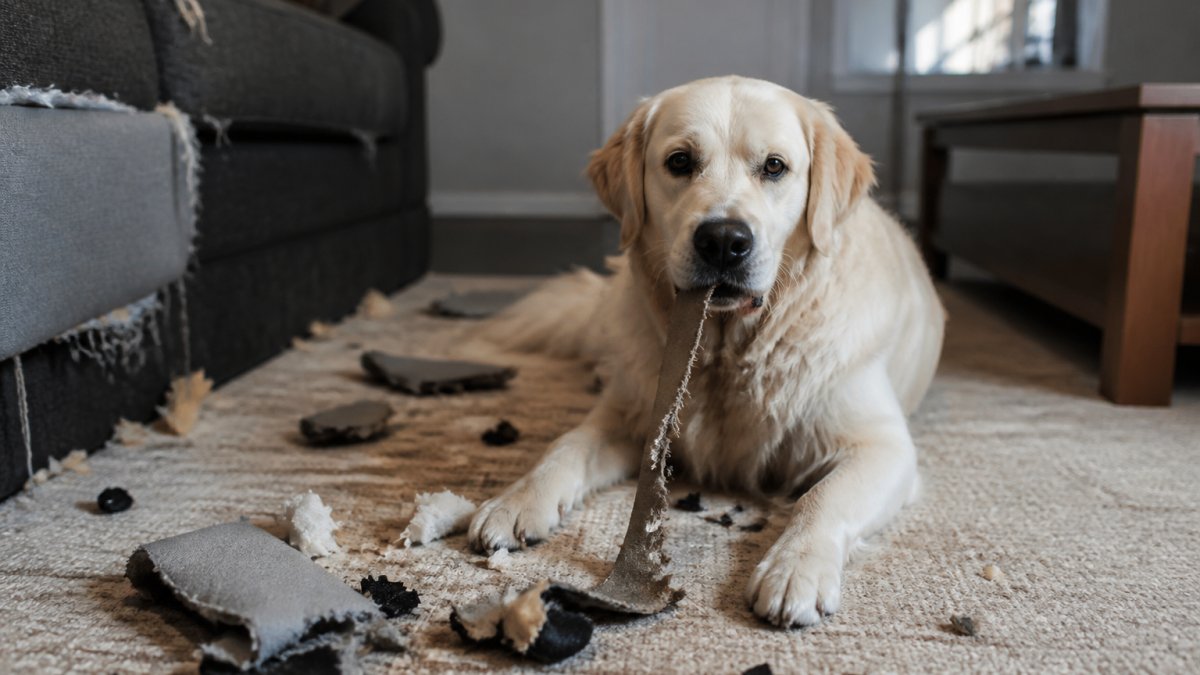
| Boredom | Anytime, worse if under-exercised | Chewing, digging, restlessness | More exercise and enrichment |
| Confinement distress | Only in the crate or small space | Scratching, drooling, escape | Rethink confinement setup |
| Incomplete house training | Predictable timing | Soiling, no distress signs | Back to basics on potty training |
How to Train a Dog to Be Alone
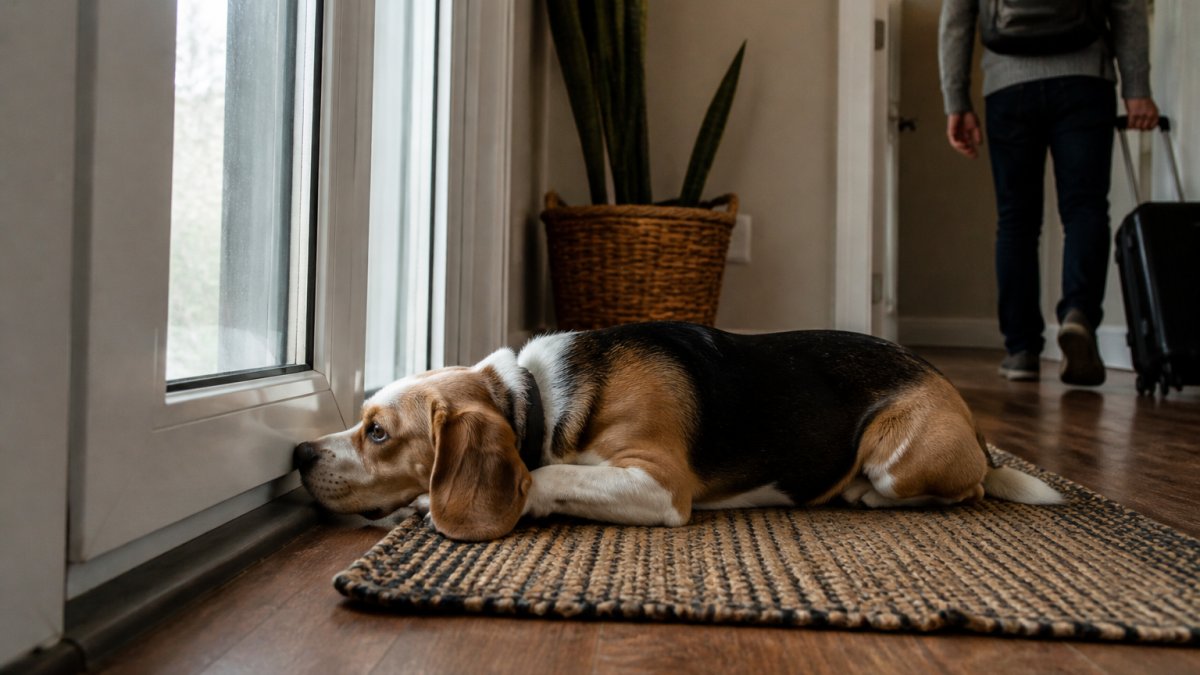
Learning how to train a dog to be alone starts with absences measured in seconds, not hours. Keep every repetition below your dog's panic threshold so the door closing stops predicting a bad outcome.
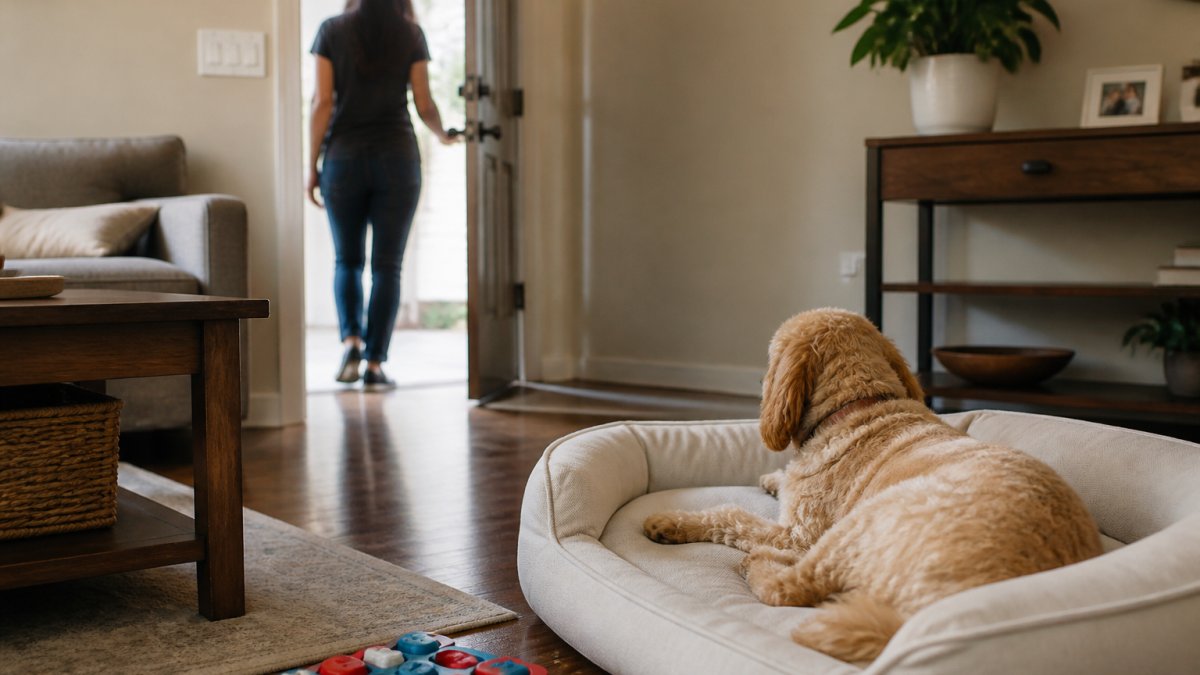
Find Your Dog's Starting Threshold First
- If distress starts at 2 minutes, your starting absence is 1 minute or less.
- If distress starts at 20 minutes, your starting absence is 10 to 15 minutes.
- If distress starts the moment the door closes, your starting point is the departure routine itself, not the absence.
Write the number down. Every session is measured against it.
The Progression: Advance, Hold, or Step Back
Run one or two sessions per day, 10 to 15 minutes each, repeating the same duration several times before changing anything. Use this decision rule after each repetition:
- Calm the whole time? Advance. Add roughly 10 to 20 percent to the duration, or move to the next step on the ladder below.
- Calm for most of it, mild signal at the end? Hold. Repeat the same duration for two more sessions before advancing.
- Panic at any point? Step back. Cut the duration by half and rebuild from there. Do not repeat a duration that triggered panic.
A simple ladder to work up:
- Pick up keys, put them down (no exit)
- Put on shoes and coat, sit back down
- Open door, close it, stay inside
Only move to the next rung when the current one produces calm on at least two consecutive sessions. Most owners try to jump from 1 minute to 30 minutes and wonder why the dog regresses.
Desensitize the Departure Routine Separately
Departure cues are the signals that predict you leaving: keys, shoes, coat, purse, the garage door, the jingle of a leash. Practice them randomly throughout the day with no exit attached: pick up your keys ten times and do nothing, put on your shoes and sit on the couch, open the door and stay inside. Make the routine boring so it stops triggering panic before the door even opens.
What to Do During Each Absence
- Leave a food puzzle or long-lasting chew so alone time is paired with something good, but do not rely on it as the whole plan.
- Keep departures and returns low-key. No long goodbyes, no excited greetings.
- Record every session on video. What you remember and what the camera shows are often different.
- Keep sessions short: five to fifteen minutes, once or twice a day. More is not better if the dog is over threshold.
When to Hold Absences and When to Push
If your dog is calm at 10 minutes but panics at 12, your working duration is 10 minutes. Stay there for several sessions, then try 11. Progress is often measured in seconds, not minutes, especially in the first two weeks. If you cannot get past a few minutes after two to three weeks of consistent work, get a professional assessment rather than keep grinding.
A Note on Realistic Timelines
Most practitioners find that mild cases improve over several weeks of daily practice, while moderate to severe cases often take several months. Progress is rarely linear. A bad session is data, not failure. Log it, step back, and rebuild. Owners who track durations and stress signals on video make faster decisions than owners who judge by feel.
Your Separation Anxiety Training Plan
A separation anxiety training plan is a written schedule of short absences that you increase only when your dog stays relaxed. Here is a simple version to start this week.
Total time per session: 10-15 minutes. Difficulty: beginner-friendly but requires consistency.
What you'll need:
- A stopwatch or phone timer
- A camera or phone to record absences
- A food puzzle or long-lasting chew
- A notebook or spreadsheet for tracking
Run one session in the morning and one in the evening. Log the absence length and your dog's reaction every time.
Desensitizing Departure Cues
Departure cues are the signals that tell your dog you are leaving: keys, shoes, coat, the garage door. Desensitizing them means breaking the link between those signals and panic. Pick up your keys ten times a day and do nothing. Put on your shoes, then sit down. Open the door, close it, stay inside. The goal is to make the whole departure routine boring.
Tracking Progress Objectively
Objective progress tracking means measuring calm absence time, not judging by feel. Track each session:
- Longest calm absence in seconds
- Any distress signals on video
- Whether your dog settled or paced
If calm time climbs week over week, you are on track. If it stalls or drops, slow down or get help. When you are ready for a structured plan with coaching, you can review the training packages we offer.
How Long Does Separation Anxiety Training Take?
What shifts the timeline:
- How long the dog has practiced the behavior
- How severe the panic is
- How consistent your sessions are
- Whether medication is part of the plan
Setbacks are normal. A bad week does not mean the plan failed. It means you hit a threshold and need to ease back.
When Training Is Not Enough: Veterinary Assessment and Medication
Some dogs need more than training, and that is not a failure. The hard part is knowing when to escalate. Most owners either wait too long or assume medication is a shortcut. Neither is right. Here are concrete triggers for a veterinary assessment and how medication fits into a training plan rather than replacing it.
Rule Out Medical Causes First
Several medical problems can look like separation anxiety or make it worse: pain, thyroid issues, cognitive dysfunction in older dogs, and gastrointestinal upset that causes house soiling. A dog who suddenly starts panicking when left alone, especially later in life, should get a veterinary exam before you build a training plan. Bring video: vets cannot observe it in the clinic, so your recording is the evidence.
Behavioral Triggers for a Vet Visit
Get a veterinary assessment if any of these are true:
- Your dog injures himself trying to escape: broken teeth, torn nails, bloody paws, damaged door frames
- Your dog stops eating or drinking when alone
- Your dog shows no measurable progress after four to six weeks of consistent, threshold-based training
- Your dog panics within seconds of the door closing, even at the shortest durations
These are not soft signals. They are the point where a training-only plan is likely to stall and the dog's welfare is at risk.
How Medication Complements Training
A common pattern is a daily medication that builds up over weeks, sometimes paired with a short-acting option for planned absences. Your veterinarian decides the protocol. Training still does the heavy lifting: the medication makes the training possible, not optional.
What to Bring to the Appointment
- Video of a typical absence, including the first 30 minutes
- Your training log: durations, dates, and stress signals observed
- A list of what you have already tried and for how long
- Notes on when the behavior started and whether anything changed (move, schedule change, new pet, loss of a companion animal)
What Training Cannot Do on Its Own
Training cannot fix an underlying medical issue, and it cannot work if the dog is over threshold every session. If your dog is injuring himself or showing no progress after weeks of steady work, the next step is a veterinary assessment, not more repetitions. If you have questions about whether your case needs professional help, our frequently asked questions cover the common concerns owners raise first.
What to Do When Absences Cannot Be Avoided
Real life does not pause for training. When you cannot avoid leaving, manage the situation so your dog stays safe.
- Use a dog sitter, daycare, or a trusted neighbor on long days
- Skip the crate if confinement makes it worse
- Remove hazards and leave a food puzzle
- Keep departures calm and low-key
Watch out: leaving a panicked dog loose in a house with escape routes can lead to injury. Safety comes before training progress.
Building Your Dog's Alone-Time Skills with Voca Springs
If you want to understand why this investment pays off, read why training works. And if you are nearby, check our service area to confirm we cover your neighborhood, then learn more about our team and how we work with owners and dogs together.
Frequently Asked Questions
Can dog training fix separation anxiety?
Training can resolve most cases of separation anxiety, but it works through gradual desensitization rather than obedience commands. The core method is teaching your dog that being alone is safe by starting with absences of seconds and building up slowly. Severe cases often need a veterinary assessment alongside training. A certified separation anxiety trainer can build a plan matched to your dog's threshold so progress is measurable rather than guesswork.
What are the most common signs of separation anxiety in dogs?
Watch for distress signals that appear within minutes of your departure: barking, howling, pacing, panting, salivation, destructive behavior, escape attempts, and house soiling in a dog that is otherwise house trained. Video monitoring is the most reliable way to confirm what happens after you leave. If your dog settles fine once you are gone and only acts up before you leave, that points to a different issue than true separation anxiety.
How long does separation anxiety training take?
Mild cases can improve in a few weeks with daily short sessions. Moderate to severe cases often take several months of consistent work, and some dogs need ongoing management. Progress depends on severity, how long the behavior has been practiced, and how strictly you avoid absences above your dog's threshold. Expect setbacks along the way; regression is normal and usually means you moved too fast, not that training failed.
When should I seek professional help for my dog's separation anxiety?
Call a professional if your dog injures itself, damages doors or crates, or cannot be left alone for even a few minutes. A veterinary assessment rules out pain and medical causes and can discuss medication for severe cases. A certified separation anxiety trainer or behaviorist can then build a structured plan. In the Caddo and Caney area, Voca Springs Dog Training works with owners on behavior modification plans that fit real home environments.
Separation anxiety is one of the most fixable behavior problems we see, but it needs a real plan and steady patience. At Voca Springs Dog Training, we specialize in behavior modification and obedience, and we build strong owner-dog bonds by coaching you as much as your dog. Our programs focus on practical, real-world results you can keep for life. Get started with Voca Springs Dog Training and give your dog the calm, confident alone time you both deserve.