 how-to
Dog Training for Aggressive Behavior Issues
Table of Contents
- Start With Safety: Immediate Steps When Aggression Appears
- Rule Out Medical Causes Before Training Begins
- Identify Dog Aggression Triggers and Early Warning Signs
- How to Calm a Reactive Dog During Triggers
- Positive Reinforcement for Dog Aggression: What Works
- Build a Dog Behavior Modification Plan Step by Step
- When to Hire a Professional Dog Trainer for Aggression
- Frequently Asked Questions
Last Updated: October 12, 2026
Start With Safety: Immediate Steps When Aggression Appears
Dog training for aggressive behavior issues starts with one rule: safety comes before training.
At Voca Springs Dog Training, we tell every owner the same thing.
Here is what to do right away:
- Separate your dog from the trigger. Use a door, gate, or leash.
- Do not grab the collar or reach toward the dog's face.
- Give the dog space and let it settle.
- Write down what happened: time, place, trigger, and body language.
Aggression is a behavior pattern where a dog uses threats or force to increase distance from something it finds threatening.
Most bites happen during everyday moments owners thought were safe. That is why the next section matters most.
Bite Prevention Basics Every Owner Should Know
Bite prevention comes down to control and distance. You will not train a dog out of aggression in a day, but you can prevent bites today.
Follow these habits:
- Keep a leash on indoors during high-risk times.
- Use a basket muzzle during vet visits and crowded walks.
- Block visual triggers with curtains, gates, or a covered crate.
- Never leave an aggressive dog alone with children.
The CDC guidance on dog bite prevention is clear that most bites are preventable with supervision and basic safety steps.
Rule Out Medical Causes Before Training Begins
Pain and illness can create sudden aggression in a dog that was previously calm.
Conditions that often show up as aggression include:
- Dental pain and infected teeth
- Ear infections
- Arthritis and joint pain
- Thyroid problems
- Vision or hearing loss
A dog in pain cannot learn. It is defending itself, not misbehaving.
Sudden aggression in an older dog deserves urgent attention. So does aggression that appears after an injury or a change in appetite.
Ask your vet for a full physical exam and bloodwork. If pain is treated, behavior often improves on its own.
Identify Dog Aggression Triggers and Early Warning Signs
Dog aggression triggers are the specific things that push a dog past its comfort level. Finding them is the core of any behavior modification plan.
Common triggers include:
- Other dogs on leash
- Strangers entering the home
- Food or toys being taken
- Being startled while sleeping
- Children running or screaming
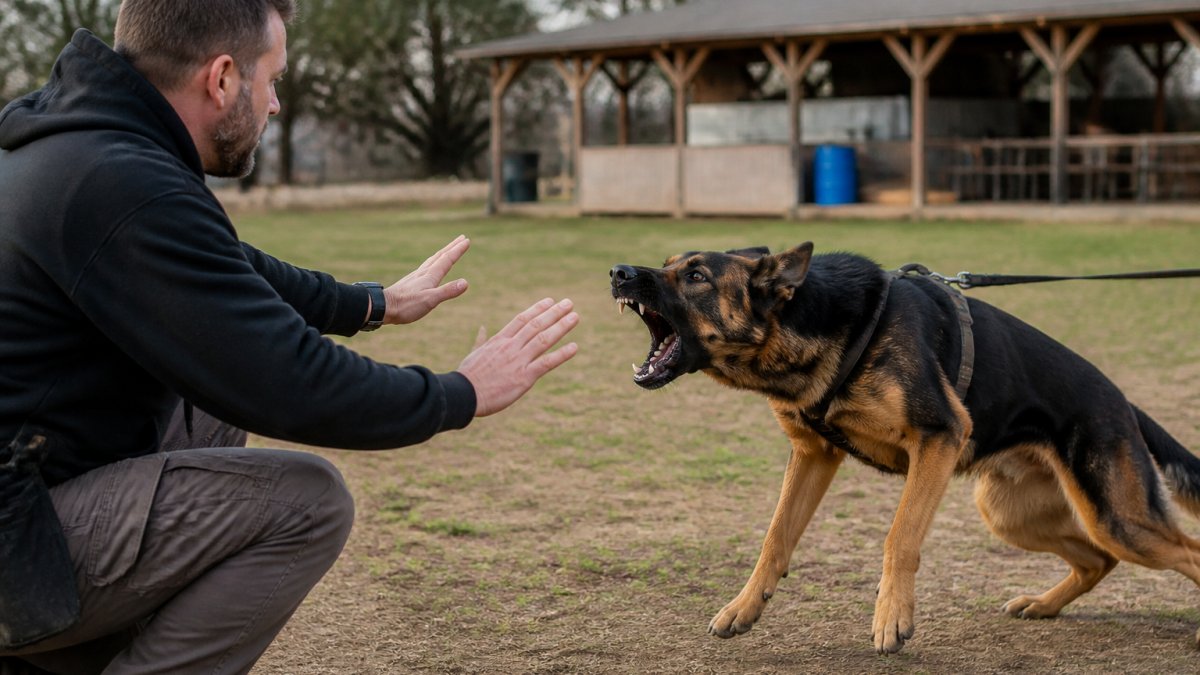
Early warning signs come before the growl. Learn them:
- Stiff body and frozen posture
- Hard stare
- Lip licking and yawning
- Whale eye, where the whites show
- Tail tucked or held high and rigid
Keep a simple log for one week. Note the trigger, the distance, and the reaction. Patterns appear fast.
Aggression type matters too. People-directed aggression, dog-directed aggression, and animal-directed aggression each need a different plan. A dog that guards food is not the same as a dog that lunges at strangers.
How to Calm a Reactive Dog During Triggers
Learning how to calm a reactive dog means changing the dog's emotional response, not just its behavior. Distance is your main tool.
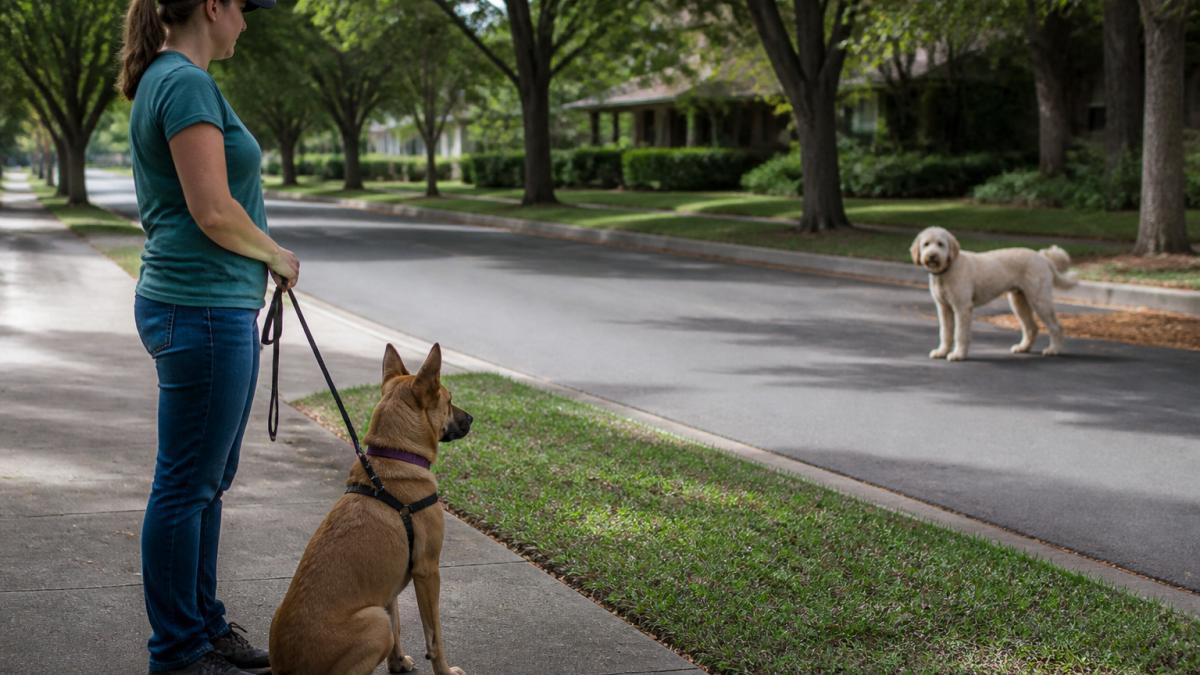
When your dog notices a trigger, follow this sequence:
- Increase distance until the dog can look at the trigger without reacting.
- Mark and reward calm behavior with treats.
- Let the dog look, then reward again when it turns back to you.
- Repeat in short sessions of five to ten minutes.
- End before the dog fails.
This is called counter-conditioning. The dog learns that triggers predict good things.
Leash Control and Safe Distance Techniques
Leash control keeps you in charge when things go wrong. A loose leash is the goal, but a backup plan saves bites.
Use these techniques:
- Hold the leash with two hands and keep it short in tight spaces.
- Keep your body between your dog and the trigger when possible.
- Turn and walk away before your dog reacts, not after.
- Use a front-clip harness to reduce pulling.
Never use a retractable leash with a reactive dog. You cannot control distance, and that is the one thing that matters most.
Positive Reinforcement for Dog Aggression: What Works
Positive reinforcement for dog aggression works because it changes how the dog feels about the trigger. Punishment suppresses behavior. It does not change emotion.
What works:
- High-value treats, used only during training
- Marking calm behavior the moment it happens
- Short, frequent sessions
- Rewarding the dog for choosing to disengage
What does not work:
- Shock collars and prong corrections
- Alpha rolls and dominance theory
- Yelling or hitting
- Flooding, which means forcing the dog to face the trigger at close range
Research from the American Veterinary Society of Animal Behavior on humane training supports reward-based methods and warns that aversive tools raise fear and can increase aggression.
A dog that feels safe learns faster. That is not soft training. It is effective training.
Build a Dog Behavior Modification Plan Step by Step
A dog behavior modification plan is a written schedule that pairs a specific trigger with a controlled response over weeks, not days. It should be specific enough that you can follow it on a bad day when your judgment is compromised.
The plan rests on four mechanisms working together:
- Management, physical control of the environment so the dog cannot practice the aggressive behavior. Every rehearsal strengthens the behavior, so prevention is training.
- Desensitization, exposing the dog to the trigger at a intensity low enough that no fear response fires, then repeating.
- Counter-conditioning, pairing the trigger with something the dog loves so the emotional response flips from threat to anticipation.
- Cue and control, teaching reliable responses (name, sit, watch, loose leash) so you have something to ask for when the dog is near threshold.
Here is a staged plan you can run with a trainer or on your own for mild cases. Adjust the pace to your dog; never move to the next stage until the current one is solid for at least five consecutive sessions.
| Stage | Focus | Daily Work | Measurable Goal Before Advancing |
|---|---|---|---|
| 0, Safety and vet | Management setup, trigger log, veterinary exam | Set up gates, barriers, muzzle conditioning, log every episode | No bites for 14 days; vet has cleared pain or illness |
| 1, Foundation cues | Name response, sit, watch, loose leash indoors | 3 short sessions per day, 3-5 minutes each, high-value treats | Dog responds to name within 1 second, 9 out of 10 tries, in a quiet room |
| 2, Threshold work | Counter-conditioning at a distance where the dog notices but does not react | 2 sessions per day near a controlled trigger | Dog looks at trigger, then looks back at you, 8 out of 10 repetitions |
| 3, Distance variation | Same trigger at closer distances and new locations | 1-2 sessions per day, vary one variable at a time | Calm at 50% of the starting distance in two locations |
| 4, Real-world practice | Walks, doorbell, visitors, car rides | Short real-world reps, end on success | Calm in three real-world settings with a helper present |
| 5, Proofing | Vary distance, location, people, time of day | 3-4 sessions per week | Behavior holds with a novel person or dog at working distance |
| Ongoing, Maintenance | Weekly practice sessions | 1-2 sessions per week | No regression over 30 days |
How to Run a Single Training Session
A session is not a walk. It is a controlled repetition with a clear start and stop. Use this structure:
- Set up before you bring the dog out. Trigger in place at the planned distance, treats in a pouch, leash on, phone silenced.
- Start below threshold. If the dog is already stiff, staring, or refusing treats, you are too close. Add distance.
- Mark and reward the moment the dog notices the trigger and stays calm. Use a clicker or a short word like "yes," then deliver the treat away from the trigger so the dog turns its head.
- Let the dog look again. The look-then-disengage pattern is the behavior you are building.
- End after 5-10 repetitions or 5 minutes, whichever comes first. Stop while the dog is still succeeding.
- Log the session using the scoring system in the next section.
What to Do When the Plan Stalls
If two weeks pass with no movement on the measurable goal, the problem is almost always one of four things:
- The trigger is too intense. Add distance, reduce duration, or change the setting.
- The reward is not valuable enough. Switch to a higher-value food used only in training.
- The dog is in pain or ill. Return to the veterinarian for a recheck.
- The behavior is rehearsing outside sessions. Tighten management so the dog is not practicing the aggressive response between training reps.
Do not add punishment to a stalled plan. Punishment suppresses the visible behavior without changing the emotion underneath, and it commonly makes the next bite more severe because the warning signs disappear first.
When to Hire a Professional Dog Trainer for Aggression
Look for a trainer who:
- Uses reward-based methods
- Has experience with aggression, not just obedience
- Asks about your dog's health history
- Involves you in every session
- Explains the plan in plain language
Ask about owner involvement before you book. You should be the one handling your dog during sessions, not watching from a chair.
For severe cases, a veterinary behaviorist may be the better fit.
At Voca Springs Dog Training, our behavior modification programs are built around tailored plans, owner involvement, and real-world practice.
Pricing depends on the program and your dog's needs. Reach out for current details.
Frequently Asked Questions
Can dog aggression be corrected with training?
Many cases improve significantly with a structured aggressive behavior training plan, but full elimination depends on the type and severity. People-directed and dog-directed aggression often respond well to behavior modification, positive reinforcement, and consistent management. Some dogs need lifelong management rather than a cure. A qualified trainer or veterinary behaviorist can assess prognosis after identifying triggers and ruling out medical causes. Expect four to six weeks before clear progress shows, with ongoing maintenance after that.
What are common triggers for dog aggression?
Common dog aggression triggers include strangers approaching, other dogs on leash, resource guarding (food, toys, resting spots), territorial intrusion, pain or illness, sudden noises, and being cornered or restrained. Fear-based reactivity often looks like aggression but stems from anxiety. Keeping a trigger log for two weeks helps you spot patterns. Once you know the specific triggers, you can control distance and intensity during training sessions and avoid surprise exposures that set progress back.
How long does behavior modification for dog aggression take?
Most owners see meaningful change in four to six weeks with consistent daily practice, but full rehabilitation can take several months. Severe cases or dogs with a long history of rehearsed aggression take longer. Progress is not linear; setbacks happen, especially during growth periods or after scary events. A dog behavior modification plan should include weekly check-ins on triggers, responses, and stress signals. If no improvement appears after six weeks of structured work, consult a veterinary behaviorist.
When should I hire a professional dog trainer for aggression?
Hire a professional trainer when your dog has bitten, broken skin, or shown aggression toward children or household members. Also seek help if you feel unsafe, if progress stalls, or if the behavior appears suddenly in an adult dog. Look for trainers who use positive reinforcement, avoid aversive tools, and involve you in every session. Ask about their behavior modification experience, credentials, and whether they coordinate with veterinarians. Pricing depends on program type and duration, so request a quote directly.
Aggression is one of the hardest things a dog owner can face, and it rarely resolves on its own. The good news is that structured, humane training changes outcomes for most dogs. Voca Springs Dog Training offers tailored behavior modification programs, hands-on owner coaching, and real-world practice that builds reliable results. Get started with Voca Springs Dog Training and build a calmer, safer life with your dog.