 how-to
Dog Training for Rural Environments: A Step-by-Step Guide
Table of Contents
- Why Rural Dog Training Differs From Urban Training
- Environmental Conditioning for Puppies in Open Spaces
- Building Dog Recall Training in Open Spaces
- Long-Line Dog Training for Safety and Reliability
- Training Dogs Around Livestock and Wildlife
- Managing Distractions and Sensory Overload
- Real-World Training and Generalization
- Frequently Asked Questions
Last Updated: October 11, 2026
Why Rural Dog Training Differs From Urban Training
Dog training for rural environments requires a fundamentally different approach than urban training. The open spaces, natural distractions, and wildlife present unique challenges that demand specialized techniques and stronger focus and more reliable recall.
In rural settings, your dog faces constant environmental stimulation, wide-open fields, moving livestock, birds, and wildlife create sensory overload that urban dogs rarely encounter. The stakes are higher: a rural dog can disappear into hundreds of acres, shaping every training decision you make.
Environmental Conditioning for Puppies in Open Spaces
Environmental conditioning starts early. Young puppies in rural areas need gradual exposure to the sights, sounds, and sensations of open land. Start with short sessions in quiet areas of your property, letting your puppy explore at their own pace for 5-10 minutes. Introduce one new stimulus at a time, wind sounds, distant farm equipment, or grazing animals at a distance, keeping sessions positive and low-pressure.
Progress gradually to busier environments:
- Week 1-2: Quiet corner of your property, 5-10 minutes daily
- Week 3-4: Larger open areas, introduce distant animal sounds
- Week 5-6: Add movement (birds flying, wind-blown objects)
- Week 7-8: Controlled exposure to livestock at safe distances
Building Dog Recall Training in Open Spaces
Recall is the foundation of rural safety. Building this skill requires measurable benchmarks, consistency across multiple environments, and honest assessment of readiness before off-leash transitions.
Starting With Short Distances and Controlled Settings
Begin indoors or in a small enclosed space. Call your dog's name followed by "come" and reward immediately with high-value treats or play. Practice 5-10 repetitions daily. Gradually increase distance from 5 feet to 20 feet, ensuring consistent success at each distance before progressing.
Add mild distractions only after your dog responds reliably in quiet spaces: introduce a toy on the ground, practice near family members, or add background noise. If your dog fails to come, return to a simpler environment and rebuild.
Measurable Recall Benchmarks
Before progressing to outdoor or off-leash training, your dog should meet these criteria:
Indoor/enclosed space (no distractions): 10 consecutive successful recalls at 20+ feet, with response time under 3 seconds.
Mild outdoor distractions: 8 out of 10 recalls succeed when mild distractions are present (distant sounds, light wind, birds in trees).
Moderate distractions: 7 out of 10 recalls succeed when moderate distractions are active (nearby movement, other people present, varied terrain). This is the minimum threshold for long-line training outdoors.
If your dog fails to meet these benchmarks, return to earlier stages. A dog that achieves 6 out of 10 recalls is not ready for the next level, regardless of how long you've been training.
Progressing to Off-Leash Control
Off-leash training in rural environments requires a methodical approach. Never rush to full off-leash freedom. Move to outdoor spaces only after consistent indoor success, using a long line (30-50 feet) in open areas to give your dog freedom while maintaining control.
Progress through these stages:
- Long line in quiet field, no distractions (goal: 10 consecutive successful recalls)
- Long line with mild distractions (goal: 8 out of 10 recalls succeed)
- Long line with moderate distractions (goal: 7 out of 10 recalls succeed)
- Drag line (trailing line, not held) in controlled space (goal: 9 out of 10 recalls succeed)
- Off-leash in fully enclosed area (goal: 10 consecutive successful recalls)
- Off-leash in open space with clear boundaries (goal: 8 out of 10 recalls succeed with real distractions present)
Troubleshooting Failed Recalls
When your dog ignores a recall command, the cause is usually one of these: the distraction is too strong (return to an earlier stage); the reward isn't valuable enough (use high-value rewards like real meat or cheese); your dog didn't learn the command in that specific location (practice in at least five different locations); or you've punished your dog for coming (always make recall positive).
When Your Dog Is NOT Ready for Off-Leash Freedom
Your dog is not ready for off-leash freedom if recall success is below 8 out of 10 in moderate distractions, has chased wildlife or livestock, shows prey drive, is under 18 months old, has a history of bolting, or lives near roads or water. If any apply, keep your dog on a long line or leash. Many rural dogs live full, happy lives on long lines or in securely fenced areas.
Long-Line Dog Training for Safety and Reliability
Long-line training bridges the gap between leash control and true off-leash freedom, giving your dog space to explore while maintaining your ability to redirect them.
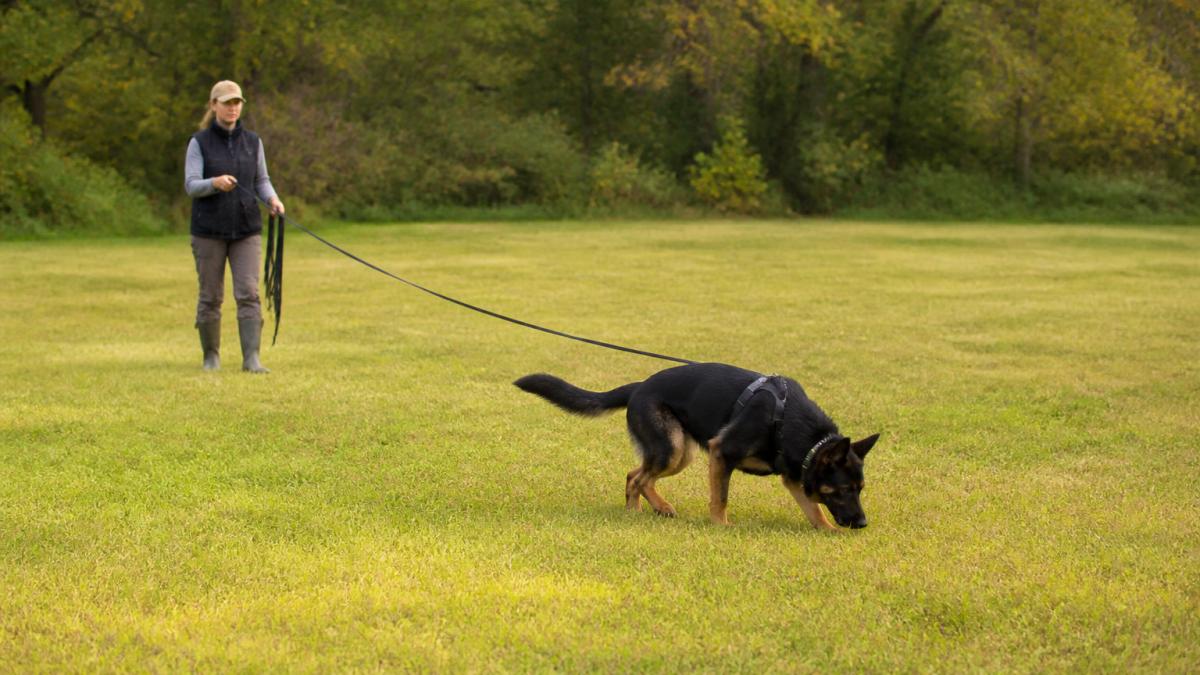
Use a 30-50 foot rope or webbing line attached to a properly fitted harness, not a collar. Avoid retractable leashes, which provide inconsistent tension and poor control.
Practice loose line walking (let the line drag while rewarding calm behavior), redirection practice (gently redirect when they pull), distance commands (call from 20+ feet away), obstacle navigation (varied terrain), and distraction response (recall when your dog notices wildlife).
Training Dogs Around Livestock and Wildlife
Rural environments introduce hazards urban dogs never face. Livestock and wildlife present both danger and temptation. Proper training requires specific distance protocols, physical barriers, and measurable behavioral milestones.
Distance Protocols and Barrier Strategies
Never assume your dog will ignore livestock. Introduce your dog to livestock gradually and under controlled conditions, using distance and barriers as your primary safety tools. Start at 50-100 feet away, depending on your dog's prey drive and livestock species. For high-prey-drive dogs, begin at 100+ feet.
Barrier strategy: Use fencing, hedgerows, terrain changes, or your vehicle as a physical barrier between your dog and livestock. Never rely on distance alone.
Supervised exposure protocol: Position your dog at the starting distance with a barrier between them and livestock. Reward calm observation. Practice 2-3 times weekly for 2-3 weeks at the same distance before decreasing by 10-15 feet.
Success criteria at each distance: Your dog should remain calm (no barking, lunging, or intense staring) for at least 5 minutes while livestock are visible.
Boundary Training and Off-Limits Areas
Establish clear boundaries that define where your dog can roam freely and where livestock areas are off-limits.
Designate zones on your property: Free zone (away from livestock, roads, water hazards), supervised zone (long line or direct supervision only), and restricted zone (livestock areas, roads, neighboring property).
Teach a boundary command: Use a consistent phrase like "boundary" or "stop" to signal that your dog has reached a forbidden area. Practice this daily near the edge of restricted zones.
When your dog approaches a boundary, say the command clearly ("boundary"). If your dog stops and turns back, reward heavily.
Physical barriers reinforce training: Install or maintain fencing around livestock areas. Hedgerows, ditches, or terrain changes also work. Your dog learns that certain areas are physically inaccessible before they learn it from correction.
Managing Chase Instincts and Prey Drive
Chase instinct is natural, not a behavioral flaw. Redirect it rather than eliminate it. Engage your dog in chase games you control: fetch with toys, tug games, chase games where your dog chases you, or scent games. These activities should happen 3-4 times weekly for 15-20 minutes. A dog that plays chase games with you regularly is less likely to chase livestock.
Preventing Chasing Incidents: Step-by-Step Protocol
If your dog has already chased livestock or shown intense interest in them, implement this protocol immediately:
Week 1-2: Containment and redirection - Keep your dog on a leash or long line at all times outdoors. Increase controlled chase games to daily practice. Practice boundary training 4-5 times weekly.
Week 3-4: Long-line exposure - Introduce long-line training near livestock areas. Practice recall with the long line at 30+ feet from livestock. Reward calm observation heavily.
Week 5-6: Distance reduction - Slowly decrease distance to livestock (10 feet per week) only if your dog remains calm. Continue long-line training and boundary command practice.
Week 7+: Supervised off-leash - After 6+ weeks of consistent calm behavior, begin supervised off-leash time in areas where livestock are visible but separated by a fence. Keep a drag line attached for the first 2-3 weeks. Expect this entire process to take 2-3 months minimum.
Wildlife Safety and Predator Awareness
Wildlife presents different hazards than livestock. Coyotes, snakes, and predatory birds pose direct threats to dogs. Teach your dog to avoid wildlife rather than chase it. If coyotes are present, keep your dog on a leash or long line during dawn and dusk (peak coyote activity). In areas with venomous snakes, teach your dog to avoid snake-like objects by practicing "leave it" with a rope or garden hose. Teach your dog to avoid standing water in rural areas, which may contain parasites or predators.
Managing Distractions and Sensory Overload
Rural environments bombard your dog with sensory input. Build focus gradually with simple indoor exercises: make eye contact, reward attention, repeat for 2-3 minutes daily. Expand to outdoor settings with minimal distractions, asking your dog to focus for 10-15 seconds while ignoring mild environmental input. Introduce distractions systematically, practice near wildlife areas, during wind or noise, in different weather, and on varied terrain. Your dog learns that commands work regardless of surroundings.
Real-World Training and Generalization
Practice commands in at least five different locations, varying time of day, weather, and environmental conditions. Test your dog's training under realistic conditions: practice recall during active play, test focus when wildlife is visible, and work during exciting moments. Real-world training reveals gaps in understanding. These failures are learning opportunities.
Building reliable dog training for rural environments takes dedication and systematic progression. The open spaces and natural distractions of rural life demand dogs with strong focus, bulletproof recall, and clear understanding of boundaries. At Voca Springs Dog Training, we specialize in behavior modification and obedience training that transfers to real-world environments, helping you build the strong owner-dog bond that makes rural living safer and more enjoyable.
Frequently Asked Questions
How do you train a dog to come when called in open spaces?
Start recall training in small, quiet areas with minimal distractions, using high-value rewards your dog loves. Gradually increase distance and introduce new stimuli once your dog responds reliably. Use a long line during the transition from leash to off-leash control to maintain safety. Practice in progressively more challenging rural environments, open fields, then areas near livestock or wildlife. Consistency and real-world practice are essential for reliable recall under competing distractions.
What's the best way to introduce a puppy to a rural environment safely?
Environmental conditioning for puppies should begin early and progress gradually. Start by exposing your puppy to quiet rural settings with minimal new stimuli, then slowly introduce natural sounds, open spaces, and wildlife at a distance. Build confidence through positive experiences rather than forcing exposure. Use a leash or long line during initial outings, and always supervise interactions with other animals. This gradual approach prevents sensory overload and establishes a foundation of confidence in larger, open acreage environments.
How can I stop my dog from chasing livestock or wildlife?
Training dogs around livestock requires establishing clear boundaries and teaching impulse control before direct interaction. Use long-line training to prevent chase behavior while teaching 'leave it' and recall commands. Start at a distance from animals and reward your dog for calm behavior rather than focused attention on them. Never allow unsupervised access to livestock or wildlife areas. Professional guidance is recommended for dogs with strong prey drive to ensure both your dog's safety and the safety of farm animals.
Why might my dog's training not stick after we finish sessions?
Dogs require ongoing practice and real-world application to maintain command reliability and generalization. Training that happens only in controlled environments often doesn't transfer to rural settings with distractions, open spaces, and new stimuli. Long-term success depends on consistent practice in your actual environment, regular reinforcement of commands, and your ability to manage distractions as they arise.