 how-to
Effective House Training for Puppies: 2026 Guide
Table of Contents
- Start House Training on the Right Foot
- Build a Puppy Potty Training Schedule That Works
- How Often to Take a Puppy Out to Pee
- How Long Does It Take to Potty Train a Puppy?
- Crate Training for Potty Training: Safe Confinement
- Read the Signs and Reward Success
- Troubleshooting Accidents and Special Situations
- Conclusion
- Frequently Asked Questions
Last Updated: October 21, 2026
Start House Training on the Right Foot
House training is teaching a puppy where and when to relieve itself, and it works best when it starts early and stays boringly consistent. At Voca Springs Dog Training, we tell every new owner the same thing: effective house training for puppies is about timing, supervision, and a schedule you follow.
Puppies do not arrive with bladder control. They develop it over months, so set them up to succeed before an accident happens.
When to Begin House Training
Start the day your puppy comes home, usually around 8 weeks old. Do not wait for shots to finish or for the puppy to "settle in." A puppy that learns the routine from day one has fewer accidents to unlearn later.
Young puppies have tiny bladders and very little control. Expect frequent trips and accidents along the way. That is normal, not failure.
Build a Puppy Potty Training Schedule That Works
A puppy potty training schedule is a written plan for when your puppy eats, drinks, sleeps, and goes outside. It does the thinking so you do not have to guess, and it must change with age: a 9-week-old and a 5-month-old do not run on the same clock.
Build the day around these fixed points, then adjust the intervals to your puppy's age and observed bladder control:
- First thing in the morning, before anything else
- After every meal, within 10 to 15 minutes
- After every nap and every play session
Keep meals on a set timetable too. Free-feeding makes potty timing unpredictable. Pick up the water bowl about two hours before bedtime once your puppy is eating well, but keep water available during the day.
Age-Specific Schedules and Realistic Bladder Control
Use these as starting points, not rigid rules. Puppies vary by breed size, metabolism, and development, so let accidents and success tell you when to stretch intervals.
- 8 to 10 weeks: Expect very little control. Plan an outdoor trip every 30 to 60 minutes while awake, plus immediately after waking, eating, and playing. Expect one or two overnight trips. Keep the puppy in sight or confined between trips.
- 10 to 12 weeks: Many puppies can stretch to every 1 to 1.5 hours while awake. Overnight, one trip is often enough, but not always. Watch for the puppy waking and fussing in the crate.
- 3 to 4 months: A common pattern is every 1.5 to 2 hours during the day and one overnight trip. This is also when many owners start adding a mid-day break if they work outside the home.
The old rule of one hour of bladder control per month of age is a useful ceiling, not a target. A 3-month-old puppy may manage three hours in ideal conditions, but not after a big meal, a long play session, or a stressful day.
A Sample Weekday Schedule for a 10-Week-Old Puppy
This is a template, not a prescription. Shift the times to fit your household, but keep the sequence and spacing.
- 6:30 a.m., Wake up, straight outside to the potty spot, reward immediately
- 7:00 a.m., Breakfast, then outside within 10 to 15 minutes
- 7:30 to 9:00 a.m., Supervised play or training, then outside every 30 to 45 minutes
Adjusting the Schedule as Your Puppy Grows
Review the schedule every two weeks. If your puppy has gone a week with no accidents and is signaling at the door, lengthen the daytime interval by 15 to 30 minutes. If accidents return, shorten it by the same amount and add a mid-day trip. Stay just ahead of your puppy's bladder, not testing it, and keep a written log of outings and accidents.
How Often to Take a Puppy Out to Pee
Take a puppy out every 1 to 2 hours while awake, plus after meals, naps, and play. A rough rule many trainers use: one hour of bladder control per month of age, up to a point. A 3-month-old often needs a trip every 2 to 3 hours during the day. That rule is a ceiling, not a target. If accidents happen, take the puppy out more often.
How Long Does It Take to Potty Train a Puppy?
Most puppies need several weeks to a few months of consistent house training before accidents become rare. Bladder control improves with age, and small breeds often take longer than large ones.
Progress is not a straight line. A puppy that was solid last week can have a bad day after a schedule change, a new food, or a stressful event.
Crate Training for Potty Training: Safe Confinement
Crate training for potty training works because most puppies avoid soiling their sleeping area. A crate is a management tool, not a punishment. Used well, it prevents accidents when you cannot watch the puppy.
Follow these rules:
- Pick a crate just big enough to stand, turn, and lie down
- Introduce it with treats and praise, never force
- Keep crate time short for young puppies
An exercise pen gives you a middle option: it limits space without full confinement, which helps during the transition.
Read the Signs and Reward Success
Supervision is the whole game in the early weeks. Keep the puppy in sight or confined, and watch for the cues that come right before an accident.
Recognizing Potty Cues
Most puppies signal before they go. Common signs include:
- Sniffing the floor in circles
- Sudden restlessness or pacing
- Whining or heading to the door
Catch the cue and get outside fast. Every successful outdoor trip is a lesson.
Positive Reinforcement That Sticks
Reward outdoor elimination every single time. Praise in the moment, then give a treat within a second or two of the puppy finishing.
Add a potty cue, a short phrase like "go potty," said as the puppy starts. Repeat it consistently and the words become a signal your puppy understands.
Never punish an accident. Scolding teaches a puppy to hide and go where you cannot see.
Troubleshooting Accidents and Special Situations
Accidents happen, even with a good plan. The difference between a puppy that improves and one that plateaus is whether the owner treats accidents as data. Track them for a week: note the time, what happened right before, where it happened, and whether the puppy had just eaten, played, napped, or been alone. Patterns show up fast.
A Measurable Troubleshooting Plan
Use a simple accident log with four columns: time, location, what happened in the 30 minutes before, and whether the puppy was supervised. At the end of the week, count accidents by category and apply the matching fix.
- Accidents cluster right after meals or within 15 minutes of eating: Tighten the post-meal trips. Take the puppy out at 5, 10, and 15 minutes after the meal until you learn its pattern.
- Accidents happen during play or right after a nap: Add a potty break before and after every play session and every nap, even if the puppy was just outside.
- Accidents happen when you are distracted or in another room: The problem is supervision, not the puppy. Use a leash tethered to you, an exercise pen, or a crate, and increase the frequency of trips.
If the log shows no clear pattern after two weeks, shorten every interval by 30 minutes and add one more trip per day. Most owners find that frequency, not correction, is the missing piece.
Apartment, Urban, and Bad-Weather Adaptations
No yard? Use the same schedule and head to a consistent outdoor spot, even if it is a short walk. In apartments and shared buildings, plan for the logistics that slow you down:
- Elevators and stairs: Time trips before the puppy is desperate. Carry a young puppy through common areas if hallway accidents are a risk, and use the stairs or elevator as part of the routine, not a race.
- Shared outdoor areas: Pick one spot and go there every time. Avoid letting the puppy greet other dogs or people until after it has eliminated, so the trip stays focused.
- Balconies and patios: Do not use them as a permanent potty spot unless you are prepared to clean and deodorize constantly. They can confuse the outdoor message and create odor problems.
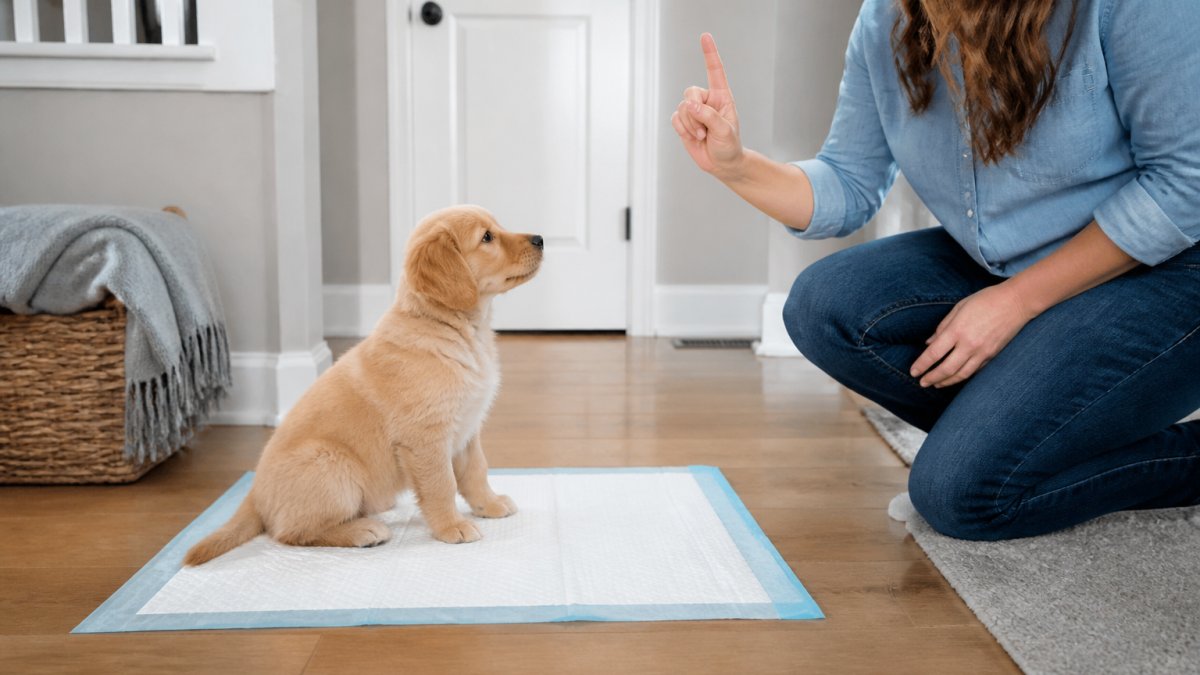
Puppy pads and indoor toilet options can help in apartments, during illness recovery, or in severe weather, but they slow the move to outdoor pottying. Use them short-term: keep pads in one location, reward elimination on the pad as you would outdoors, and transition by moving the pad closer to the door over a week or two, then outside. Do not mix pads and outdoor trips randomly.
House Training for Working Owners and Multi-Person Households
A puppy does not care who takes it out, but it does notice when the rules change. In multi-person households or with a working owner, consistency is the whole game.
- Write the handoff: Post the schedule and the accident log where everyone sees it. The person who takes the morning shift should know what the evening person did.
- Use the same cue: Everyone says the same potty phrase, uses the same door, and goes to the same spot. Different cues and routes slow learning.
- Plan the midday break: For owners who work outside the home, arrange a midday visit from a family member, neighbor, or professional dog walker. A puppy under 4 months usually cannot stretch a full workday.
When to Rule Out Medical Causes
Sudden changes in potty habits can have a medical cause. Talk to your veterinarian if you notice:
- Accidents after weeks of solid progress
- Frequent urination in small amounts
- Straining, crying, or blood in urine
A house training problem that appears out of nowhere is worth a vet visit before you change the training plan. Urinary tract infections, parasites, and other common puppy health issues can look like training failures, and no schedule fixes a medical problem.
Conclusion
House training a puppy takes weeks of small, repeated wins, and the hardest part is staying consistent when you are tired or busy. A written schedule, close supervision, safe confinement, and fast rewards handle most of it. For hands-on help building a routine that fits your home, Voca Springs Dog Training offers obedience and behavior modification programs built around your dog and your daily life.
Frequently Asked Questions
What is the 10-10-10 rule for puppy potty training?
The 10-10-10 rule is a simple guideline for the first few days after bringing a puppy home: take them out every 10 minutes during active play, every 10 hours overnight, and within 10 minutes of eating or drinking. It works because puppies have tiny bladders and short attention spans. Pair it with a consistent puppy potty training schedule and adjust as your puppy's bladder control improves with age.
How often should you take a puppy outside to potty?
A common rule is one hour of bladder control per month of age, up to about eight hours for adult dogs. A two-month-old puppy needs a break roughly every two hours, plus immediately after waking, eating, drinking, and play. Young puppies also need one overnight potty break. When figuring out how often to take a puppy out to pee, err on the side of more frequent outings to prevent indoor accidents.
Should you use a crate when house training a puppy?
Yes, when used correctly. Crate training for potty training works because dogs naturally avoid soiling their sleeping area. Choose a crate just large enough for your puppy to stand, turn around, and lie down. Keep crate time short for young puppies and always take them straight outside after opening the crate. Never use the crate for punishment, and never leave a puppy confined longer than their bladder can handle.
What should you do when your puppy has an accident indoors?
Stay calm and avoid scolding, which can teach a puppy to hide potty behavior rather than stop it. Clean the spot immediately with an enzyme cleaner to remove odor that attracts repeat accidents. Then review your routine: increase outdoor potty breaks, tighten supervision, and reward every successful outdoor elimination. If accidents suddenly increase in a previously reliable puppy, check with your veterinarian about possible medical causes.