 how-to
How to Stop Dog Reactivity on Walks: A Step-by-Step Guide
Table of Contents
- Why Your Dog Reacts on Walks (and What's Really Happening)
- Step 1: Find Your Dog's Trigger Distance and Work Below It
- Step 2: How to Redirect a Reactive Dog During a Trigger Encounter
- Step 3: How to Stop a Dog From Barking at Other Dogs on Walks
- Choosing the Right Reactive Dog Walking Equipment
- How Long Does It Take to Train a Reactive Dog?
- When to Get Professional Help for Dog Reactivity
- Frequently Asked Questions
Last Updated: October 16, 2026
Why Your Dog Reacts on Walks (and What's Really Happening)
That lunging, barking, and pulling at the end of the leash is not your dog being stubborn. At Voca Springs Dog Training, we understand that a dog who is calm at home can turn into a different animal three blocks away.
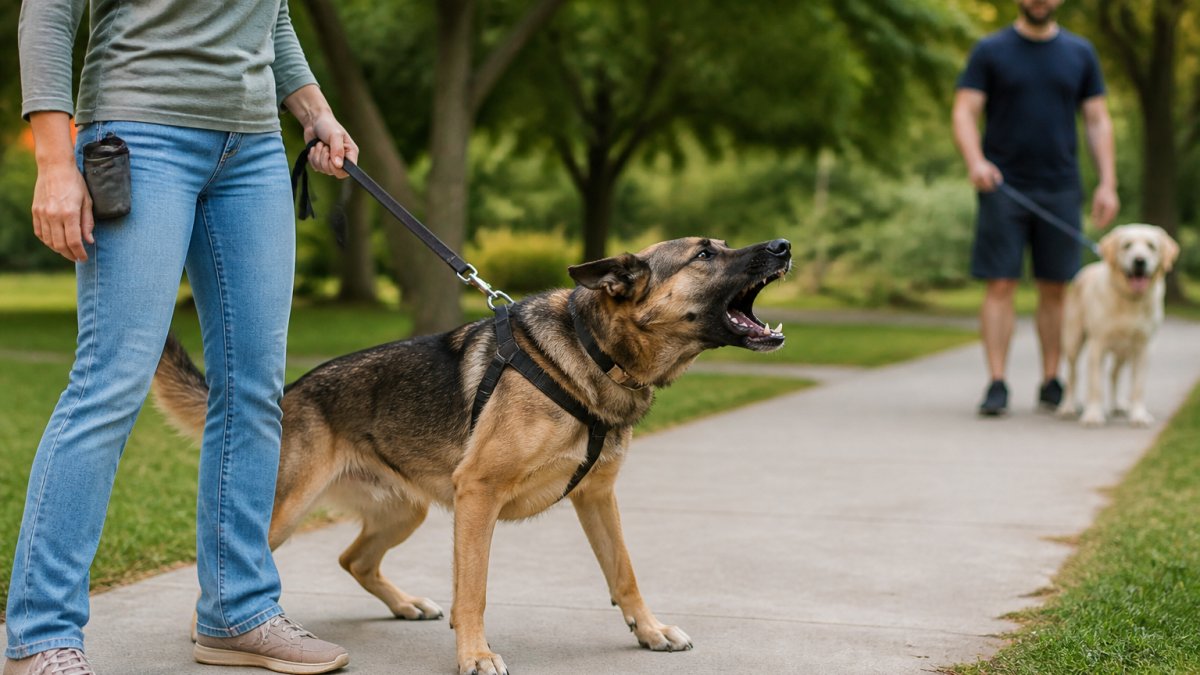
Dog reactivity is an over-the-top emotional and behavioral response to a specific trigger, most often other dogs or passers-by, while on a leash. The leash is key: it removes your dog's ability to flee, leaving only fight, freeze, or noise.
Fear, Frustration, and Overarousal: The Three Main Drivers
Most reactive dogs fall into one of three groups, and the fix depends on which one you have.
- Fear: Your dog is scared of the trigger and wants it gone. The barking is a bluff to create distance.
- Frustration: Your dog wants to greet but the leash blocks it. Common in friendly dogs who never learned to pass politely.
- Overarousal: Your dog gets so wound up that thinking shuts down. It looks like frustration, but the dog cannot calm down afterward.
The three can overlap and shift. That matters because a fear-based dog and a frustrated greeter need different plans.
Recognizing Early Warning Signs Before the Bark
Barking is the last step, not the first. Catch the earlier signals and you can act.
- Stiff body and a hard stare
- Ears pinned back or locked forward
- Lip licking, yawning, or a sudden shake-off
Spot them and you can create space before the explosion. Miss them and you are managing a reaction instead of preventing one.
Step 1: Find Your Dog's Trigger Distance and Work Below It
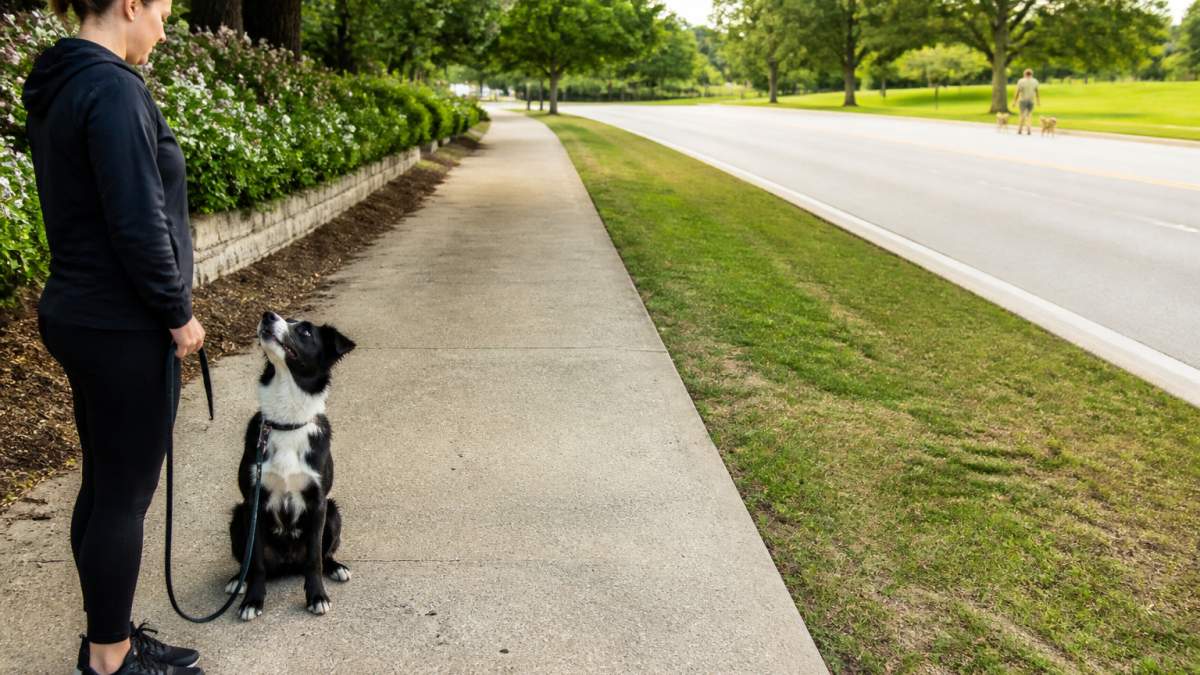
Your dog's trigger distance is the closest a trigger can be before your dog notices it and starts to react. Find that line and stay well behind it. Most owners work far too close, then wonder why every walk turns into a wrestling match.
Here is how to find it:
- Pick a quiet spot with good sightlines, like a park edge or a wide sidewalk.
- Have a helper with a calm dog stand at least a full block away.
- Walk parallel to the helper and watch for the first warning sign.
- Mark the distance where your dog notices but stays calm. That is your working distance.
- Reward calm behavior the moment your dog looks at the trigger and back at you.
If your dog reacts, you were too close. Add distance and try again. That is not failure; it is data.
Step 2: How to Redirect a Reactive Dog During a Trigger Encounter
When a trigger appears with no warning, you need a plan you can run without thinking. Here is a protocol for an actual encounter.
- Create space first. Turn and walk away, or step behind a parked car. Distance lowers arousal fastest.
- Get your dog's attention. Say your dog's name once, cheerfully. Do not repeat it.
- Ask for a simple behavior. A "find it" treat toss or a hand target works well. Nose work calms dogs fast.
- Reward the disengage. The moment your dog looks away from the trigger, mark it and pay.
- Move past or away. Keep walking with a loose leash. Do not stop and stare.
If your dog is already over threshold, skip steps 2 through 4. Create distance and let your dog recover. You cannot train a dog who is not thinking.
Step 3: How to Stop a Dog From Barking at Other Dogs on Walks
Stopping the barking means changing how your dog feels about other dogs, not just suppressing the noise. Two tools do most of the work: desensitization and counterconditioning.
Desensitization is gradual exposure at a distance where your dog stays calm. Counterconditioning pairs the trigger with something good, usually high-value treats, so it predicts good things instead of scary ones.
Put them together:
- Start below your dog's trigger distance.
- Let your dog notice the other dog.
- Feed treats the instant your dog sees the trigger, before any reaction.
That look-back is the goal: your dog is starting to associate other dogs with good outcomes.
Choosing the Right Reactive Dog Walking Equipment
Gear does not train your dog, but the wrong setup can undo a good session and put both of you at risk. The goal: two points of control, no throat pressure, and no way to slip free during a reaction. This is the safety layer most guides skip.
The Core Setup
| Equipment | Best For | Why It Helps | Watch Out For |
|---|---|---|---|
| Front-clip harness | Most reactive dogs | Redirects pulling forward and sideways without throat pressure | Check fit monthly; a loose harness lets a dog back out |
| Martingale collar | Dogs who back out of flat collars | Tightens only enough to prevent slipping | Never use for leash corrections or as the primary walking tool |
| Double-ended leash | Two-point control | Clips to harness and collar for a backup connection | Can tangle if you rush a redirect |
| Basket-style muzzle | Dogs with a bite history or high arousal | Prevents bites during training and vet visits | Must allow panting and treat delivery; condition slowly |
| 6-foot leather or biothane leash | Everyday walks | Durable, easy to grip, no slack surprises | Skip retractable leashes entirely |
Retractable leashes are a poor fit for reactive dogs: they teach constant pulling, put your hand far from the brake, and give no control when a trigger appears around a corner.
Fit Checks That Prevent Escapes
A dog who can back out of a collar during a reaction is a loose dog near a trigger, the worst-case scenario. Run these checks before every walk:
- Two-finger rule. Fit two fingers between the strap and your dog's body. Tighter restricts breathing; looser invites slipping.
- Harness girth and chest straps. The chest strap should sit behind the shoulder blades, not across the throat. A strap that rides forward rubs and restricts.
- Backup connection. Clip the second end of a double-ended leash to a martingale or second collar. If one point fails, you still have control.
When a Muzzle Is Appropriate
A muzzle is not a punishment or an admission of failure. It is a safety tool for dogs who have bitten, have an unverifiable bite history, or escalate too fast to guarantee a safe distance. A basket-style muzzle lets your dog pant, drink, and take treats, so training continues while it is on.
Condition it slowly:
- Show the muzzle, feed treats through the front opening, then put it away. Repeat over several short sessions.
- Hold it so your dog puts their nose in voluntarily to reach a treat.
- Buckle it for one second, feed, remove. Build duration gradually.
- Practice on calm walks before you ever need it near a trigger.
How Long Does It Take to Train a Reactive Dog?
There is no fixed timeline, and anyone who promises one is guessing. Progress depends on your dog's history, the cause of the reactivity, how often you train, and how well you manage triggers between sessions.
Progress is measurable. Track these markers:
- The distance at which your dog can stay calm
- How quickly your dog recovers after a reaction
- How many calm pass-bys you get per walk
Most owners see the first real change within a few weeks of consistent, below-threshold work. Full reliability around other dogs often takes months, not days. Setbacks are normal.
When to Get Professional Help for Dog Reactivity
Training alone cannot fix every reactive dog, because not every reactive dog has a training problem. Pain, thyroid changes, vision or hearing loss, and anxiety disorders can all look identical to leash reactivity. Before investing months in a training plan, rule out the medical side.
Rule Out Pain and Health First
A dog who suddenly becomes reactive, or whose reactivity worsens without an obvious trigger, needs a veterinary check before a training overhaul. Common culprits:
- Dental pain or ear infections, which make a dog defensive about being approached.
- Orthopedic pain such as hip, knee, or back issues, which makes a dog guard their space on leash.
- Thyroid dysfunction, which can present as irritability and anxiety.
Ask your veterinarian for a full physical exam and baseline blood panel. If your vet finds nothing, that is useful information, not a dead end, you can commit to a behavior plan with confidence.
Red Flags That Mean Stop and Get Help
Do not wait for a crisis to call a professional. Seek help when any of these apply:
- Your dog has bitten a person or another animal, or you have seen a bite attempt.
- Reactions are escalating in intensity or frequency despite consistent training.
- You feel unsafe handling your dog, or you are avoiding walks entirely.
What a Qualified Professional Looks Like
Not every trainer is equipped for behavior modification. Look for someone who:
- Uses force-free, reward-based methods and can explain the science behind them.
- Has specific experience with reactivity and aggression, not just general obedience.
- Will coordinate with your veterinarian.
Ask directly about punishment. If the answer involves shock, prong, or choke corrections for a fearful dog, keep looking. Punishment adds stress to an already stressed animal and frequently worsens reactivity.
What Progress Actually Looks Like
Voca Springs Dog Training works with owners across Caddo and Caney, Oklahoma, and the surrounding area on these types of problems. We specialize in behavior modification and obedience, and coordinate with your veterinarian when health could be a factor. Our focus is on empowering owners with the skills to maintain long-term training and build a stronger bond with their pets.
Frequently Asked Questions
Can leash reactivity be trained out of a dog?
Yes, most dogs can make significant progress with consistent training. Dog reactivity is a behavior pattern, not a fixed personality trait. The key is working below your dog's threshold, rewarding calm behavior, and keeping sessions short. Severe cases may need professional behavior modification, but the majority of reactive dogs improve with a structured plan using counterconditioning and desensitization over several weeks to months.
What should I do when my dog reacts to a trigger on a walk?
Create space immediately. Turn and walk the other direction, cross the street, or step behind a parked car. Do not correct or yell, which adds stress. Once your dog is far enough away to stop lunging and barking, reward any calm behavior with treats. This teaches your dog that moving away from a trigger leads to good things and helps reset their emotional response over time.
How far away should my dog be from a trigger during training?
Your dog needs to be far enough away that they notice the trigger but can still eat treats and respond to you. This is called working below threshold. For some dogs that means 50 feet or more; for others, 15 feet works. Watch for stiff body language, staring, or refusing food. If any appear, you are too close. Increase distance and try again at a calmer starting point.
When should I get professional help for leash reactivity?
If your dog has bitten another dog or person, if reactivity is getting worse despite consistent training, or if you feel unsafe on walks, seek professional help. A qualified trainer or veterinary behaviorist can assess whether the behavior stems from fear, anxiety, or a medical issue. Early intervention prevents rehearsed reactivity patterns from becoming harder to change and keeps everyone safer on walks.
A reactive dog is not a broken dog, and you are not failing. The challenge is that most owners never learn to read the early signs or work below their dog's trigger distance, so every walk stays a battle. Voca Springs Dog Training can help you change that with tailored behavior modification, hands-on coaching in real-world settings, and a plan built around your dog's specific triggers. Get started with Voca Springs Dog Training and turn your daily walk into something you both look forward to.