 how-to
7 Steps to Find Adult Dog Obedience Classes Near You
Last Updated: November 4, 2026
Quick Summary
Adult dog obedience classes are structured training programs for dogs past their first year, built around existing habits like leash pulling, ignored recall, and reactivity. Owners should first define their goals, then compare group classes with private lessons, and check screening, vaccination requirements, and total pricing before enrolling.
- Write down the three behaviors causing the most trouble before comparing any class.
- Group classes suit dogs that handle distraction; private lessons suit dogs that struggle around other dogs or people.
- Ask about bite history, reactivity triggers, and vaccination requirements before your first class.
- Compare providers by total cost per skill learned, including assessment fees, session length, and follow-up support.
- Practice in short five-to-ten-minute sessions and move from the living room to busier places as your dog improves.
Table of Contents
- Why Adult Dogs Need Their Own Obedience Plan
- Step 1: Define Your Training Goals Before You Search
- Step 2: Compare Group Classes and Private Lessons
- Step 3: Check Class Levels, Screening, and Behavior Fit
- Step 4: Review Adult Dog Obedience Classes Near Me Prices
- Step 5: Evaluate Professional Dog Behavior Modification Services
- Step 6: Plan Your Dog Obedience Training Duration
- Step 7: Prepare for the First Class and Practice at Home
- Booking Your First Adult Dog Obedience Session with Voca Springs
- Frequently Asked Questions
Why Adult Dogs Need Their Own Obedience Plan
Many owners assume a dog past its first year is too set in its ways to learn. That assumption is common, and it is mostly wrong. Adult dogs learn well, but they arrive with habits, and those habits need a plan built for them. A puppy class teaches a blank slate. An adult dog already knows what gets rewarded, and sometimes what gets rewarded is the behavior you want to stop.
This is why a generic class often falls short. Adult dogs need instruction that addresses existing patterns, whether that is pulling on leash, ignoring recall, or reacting to other dogs on walks.
Adult obedience also builds on a dog's existing skills. Most adult dogs already know some commands, so the work is often refining them: a sit that holds through a distraction, a stay that lasts while the door opens. Owners searching for adult dog obedience classes near me are usually looking for exactly this kind of focused, practical instruction.
Step 1: Define Your Training Goals Before You Search
Before you compare schedules or prices, decide what you need the training to do. A clear goal narrows your search quickly and keeps you from paying for skills you will never use.
Start with a short list. Write down the three behaviors that cause the most trouble in daily life. Common examples include:
- Pulling hard on walks
- Ignoring recall in open spaces
- Jumping on guests or greeting strangers poorly
- Reacting to other dogs, people, or bicycles
- Getting anxious when left alone
Next, separate basic manners from behavior problems. Basic obedience covers sit, stay, down, come, and loose-leash walking. Behavior modification addresses reactivity, anxiety, or aggression, and usually needs a more structured program. If your dog bites, lunges, or shuts down under stress, say so when you contact a trainer. That detail changes which class or program fits.
Finally, note what you want the dog to do in real life. A dog that performs well at a training center may still struggle in your neighborhood. Owners who plan to practice on their own street, in a park, or at a feed store should say that clearly, because real-world practice is where most results are either built or lost.
Step 2: Compare Group Classes and Private Lessons
Group classes and private lessons serve different needs, and the right choice depends on your dog's temperament and your goals.
Group classes work well for dogs that handle distraction reasonably and need practice with other dogs nearby. They are often less expensive per session, and they teach owners to keep control in a shared space.
Private lessons suit dogs that struggle around other dogs or people. They also suit owners who want instruction tailored to a specific problem. One-on-one sessions let a trainer focus entirely on your dog's triggers and your handling. They tend to cost more per session but can move faster on targeted behavior.
| Option | Best for | Typical setting | Trade-off |
|---|---|---|---|
| Group class | Basic obedience, socialization practice | Shared training space | Less individual attention |
| Private lessons | Reactivity, anxiety, specific goals | One-on-one or in-home | Higher cost per session |
Some owners start with private lessons to stabilize a problem, then move to a group class to generalize the skills. That sequence is often effective, though it depends on your dog's progress.
Step 3: Check Class Levels, Screening, and Behavior Fit
Adult dogs arrive with established habits, so placement matters more than it does for puppies. A reputable program will screen before admitting a dog to a group setting, and the screening should cover both the dog's behavior history and the owner's goals. Ask directly how the trainer assesses fit, and expect specific questions rather than a simple registration form.
A thorough screening typically covers:
- Bite history, Any bite that broke skin, even a single incident, usually calls for private assessment before group work. A trainer who does not ask about bite history is a red flag.
- Reactivity triggers, Ask whether the program separates dogs that react to other dogs, to people, or to specific stimuli such as bicycles or uniforms. Group classes that mix reactive dogs with calm ones without visual barriers put every dog at risk.
- Vaccination and health status, Most group programs require proof of current rabies and DHPP vaccination, and some require a recent negative fecal test. Confirm the requirements before your first class so you are not turned away at the door.
- Age and physical condition, Adult dogs with arthritis, vision loss, or hearing loss may need modified equipment or shorter sessions.
- Owner handling comfort, Some adult dogs are fine with other dogs but their owners are not confident handling a leash in a crowded room.
Class levels should map to skills, not just to dog age. Ask what specific skills each class level covers and what assessment moves a dog from one level to the next.
Class size is the other half of fit. Smaller groups generally allow more individual feedback, but the right number depends on the trainer's format. Ask the student-to-instructor ratio, not just the total enrollment.
Watch out: Ask what happens when a dog is not a fit for group class, and whether the trainer refers to private lessons or a behavior specialist.
Step 4: Review Adult Dog Obedience Classes Near Me Prices
Pricing for adult dog obedience classes varies widely by format, program length, and what is bundled into the fee. For a closer look at what moves the price of one-on-one work, see the factors that affect private session costs. The most useful comparison is not the sticker price of a single session but the total cost per skill learned and the support included after class ends. Providers often structure pricing in different ways, such as per-session rates, multi-week packages, or flat program fees.
Ask each provider to break the total into components so you can compare like with like:
- Assessment or evaluation fee, Some programs charge a separate fee for a temperament or behavior screening before placement. Ask whether this is credited toward tuition if you enroll.
- Number of sessions and session length, A six-week class meeting once a week for 45 minutes is not equivalent to an eight-week class meeting twice weekly. Calculate total instructional hours, not just session count.
- Group versus private rate, Group classes are typically priced per dog for the full course, while private lessons are usually priced per session or in packages of four to six. Ask whether private packages discount the per-session rate.
- Materials and equipment, Some programs include a training collar, clicker, treat pouch, or printed workbook; others charge separately. Confirm what you take home and what you must buy.
- Make-up and refund policy, Ask what happens if your dog misses a class due to illness or a behavior setback. Programs that offer make-up sessions or prorated refunds reduce your risk.
- Follow-up support, Some trainers include email check-ins or a group practice session after the course ends. That support has real value and should factor into the comparison.
Compare two or three programs using the same cost-component checklist so the numbers are genuinely comparable.
Voca Springs Dog Training does not publish standard rates because program costs depend on the training format, the number of sessions, and the behaviors being addressed. You can compare the actual training packages and what each one includes on the Packages page. For current pricing or a quote tailored to your dog, contact Voca Springs Dog Training directly through its website.
Step 5: Evaluate Professional Dog Behavior Modification Services
If your dog reacts strongly to people, dogs, or other triggers, general obedience may not be enough. Behavior modification addresses the emotional response behind the behavior, not only the visible action. This work usually takes longer and requires a trainer experienced with reactivity or anxiety.
When you evaluate providers, ask about their experience with the specific issue you face. Ask how they measure progress, how they involve the owner, and what happens between sessions. You can read a guide to finding local behavior modification services to compare providers before you choose. Our team at Voca Springs Dog Training focuses on that owner-dog partnership, and you can learn more about our approach to behavior modification on our About Us page.
Also ask whether the trainer assesses whether the behavior may have a medical or anxiety-related cause. Some problems need a veterinarian's input alongside training. A trainer who recognizes that limit is usually a safer choice than one who promises to solve everything.
Step 6: Plan Your Dog Obedience Training Duration
Training length depends on your dog's history, the behaviors involved, and how consistently you practice.
Plan for the full timeline before you enroll. Ask the provider how long a typical program runs, how often sessions meet, and what progress looks like at each stage. Many owners underestimate how much practice happens outside class. The sessions set the foundation, but the daily repetitions build reliability.
Expect some regression. Adult dogs often slip when routines change, when new distractions appear, or when training stops. Ask your trainer how they structure the transition after formal instruction ends.
Step 7: Prepare for the First Class and Practice at Home
Arrive early to your first class with your dog's leash, a standard collar or harness as the trainer instructs, and a supply of small, soft treats. Bring a bag of high-value rewards your dog reliably responds to, since distractions in a new space can make ordinary treats less interesting.
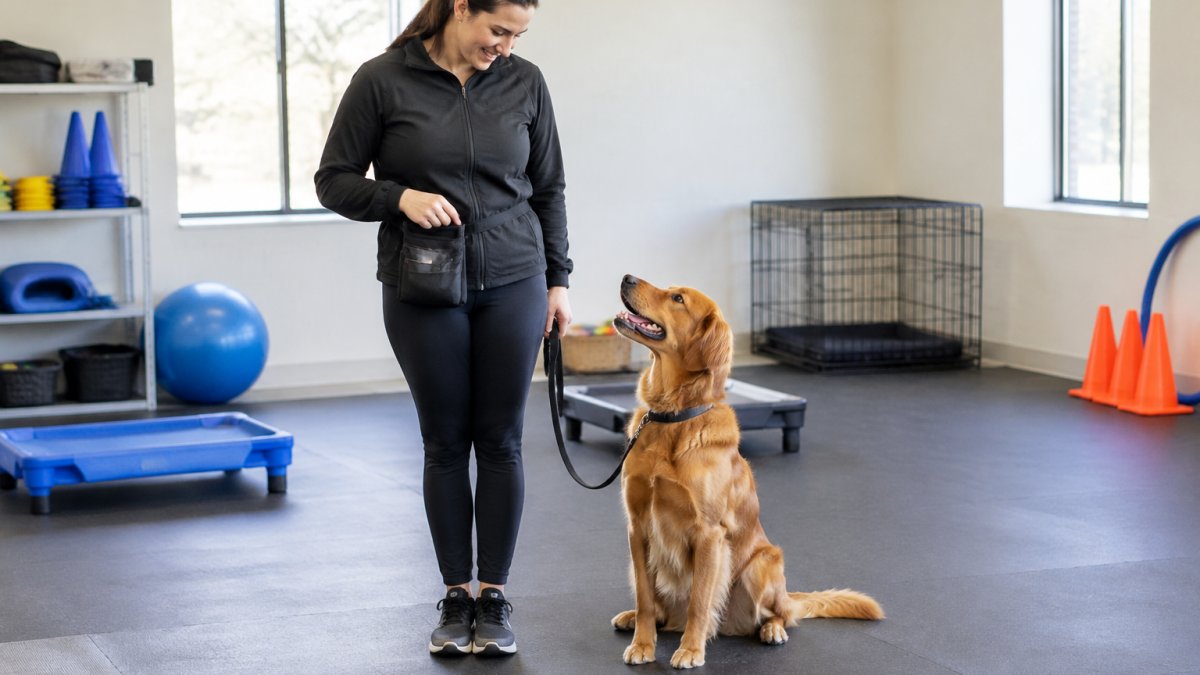
!An adult dog sitting attentively beside its owner on a leash in a bright training room, with the owner holding a treat pouch
Expect the first session to be partly an assessment. Answer questions honestly, including any history of aggression or fear. Accurate information lets the trainer plan lessons that work.
Between classes, practice in short sessions of five to ten minutes. Use the same cues the trainer teaches, and reward the behavior you want immediately. A common mistake is practicing only in the living room. Move to the backyard, then the sidewalk, then busier places as your dog improves.
Booking Your First Adult Dog Obedience Session with Voca Springs
Adult dogs can learn new habits, but the right plan makes a real difference. Start by defining your goals, compare group and private options, and ask hard questions about screening, pricing, and timeline. Voca Springs Dog Training offers obedience and behavior modification services, from basic manners to complex behavioral challenges. To find out which option fits your dog, contact Voca Springs Dog Training to schedule a consultation and discuss your dog's specific needs.
Frequently Asked Questions
How much do adult dog obedience classes near me cost?
Pricing depends on the class format, session length, number of sessions, and whether lessons are group or private. Group classes usually cost less per session than private lessons because the trainer's time is shared. Because pricing varies by program, the most reliable approach is to request a written quote that lists the number of sessions, what each session covers, and any materials or follow-up support included. Voca Springs Dog Training can share current program pricing on its website or through a direct quote request.
Can an adult dog with reactivity or anxiety benefit from obedience classes?
Yes, many adult dogs with reactivity or anxiety benefit from structured obedience work, but class suitability depends on the dog's behavior. A good program screens for aggression, fear, and reactivity before enrolling a dog in a group setting. Dogs that struggle around other dogs may need private lessons first. Owners should ask whether the trainer assesses behavior at intake and how the class handles dogs that need extra space.
How long does dog obedience training take to show results?
Most programs run for several weeks, and progress depends on how often the dog practices at home. Owners who practice short sessions daily tend to see faster improvement than those who attend class only. Ask the trainer what measurable goals to expect, such as reliable sit, down, or recall in a distracting environment, and how many weeks of practice are needed to reach them.
What should I look for when choosing a dog trainer for an adult dog?
Look for a trainer who asks about your dog's history before recommending a program, explains training methods clearly, and uses positive reinforcement. Check whether they offer group classes or private lessons, whether they serve your area, and whether they provide practice guidance between sessions. Clear communication about goals, pricing, and what happens if progress stalls is a strong sign of a dependable trainer.