 how-to
How to Train Dog Recall for Reliable Off-Leash Response
Last Updated: November 3, 2026
Quick Summary
To train dog recall, pick one short cue like come, practice indoors with zero distractions, and reward every return instantly with high-value treats or play. Then add distance and distractions gradually on a long line, advancing only when your dog comes on the first cue in at least eight of ten tries.
- Say the recall word once and never repeat it in a string.
- Keep indoor sessions short, around two to three minutes, and end on a win.
- Attach the long line to a harness, not the collar, to protect your dog's neck.
- Add no more than about five feet of new distance at a time.
- Condition a separate emergency cue and practice it monthly in low-stakes settings.
Table of Contents
- What Recall Means and Why It Matters for Off-Leash Safety
- Choosing Dog Recall Words That Stick
- Step 1: Teach the Cue Indoors With Zero Distractions
- Step 2: Reward Every Return With High-Value Treats and Play
- How to Train a Dog Recall With a Long Line
- Dog Recall Training With Distractions: A Staged Progression Plan
- How Long Does It Take a Dog to Learn Recall?
- Troubleshooting Recall by Cause: Why Your Dog Doesn't Come
- Emergency Recall and Safety Rules Every Owner Should Know
- Recall for Puppies, Adolescent Dogs, and Adult Rescues
- Frequently Asked Questions
What Recall Means and Why It Matters for Off-Leash Safety
Dog recall is the trained behavior of coming when called, every time, no matter what else is happening. It is the single most important safety skill your dog can learn. A dog who comes reliably can enjoy off-leash time without the constant fear of traffic, wildlife, or a gate left open.
At Voca Springs Dog Training, we treat recall as the foundation of off-leash freedom, not an optional trick. The stakes are simple: a dog who ignores a recall cue near a road is in real danger.
Most owners think recall means "my dog comes back eventually." That is not recall. True recall is immediate and consistent, even when something more interesting is nearby.
Reliable recall is widely recognized as a core obedience skill. It protects your dog and gives you peace of mind. Below, we break down how to train dog recall step by step, from the first indoor repetition to off-leash reliability in the real world.
Choosing Dog Recall Words That Stick
Pick one short, clear word and use it every single time. "Come" works well because it is easy to say in a hurry. Avoid using your dog's name as the cue, and never repeat the word in a string. Say it once, then wait.
A good recall word has three traits:
- One or two syllables
- Easy to say loudly and cheerfully
- Never used for anything negative
Consistency matters more than the word itself. If everyone in the household uses the same cue, your dog learns faster.
Why Your Dog's Name Is Not the Recall Cue
Your dog's name means "look at me," not "run to me." If you use the name as the cue, your dog learns to glance your way and then go back to sniffing. Keep the name for getting attention, and save the recall word for the actual return.
Using a Whistle or a Second Emergency Word
A whistle carries farther than your voice and stays consistent in tone. Many handlers pair a whistle with a backup emergency word for safety. The whistle becomes a distinct, unmissable signal your dog can hear across a field.
Step 1: Teach the Cue Indoors With Zero Distractions
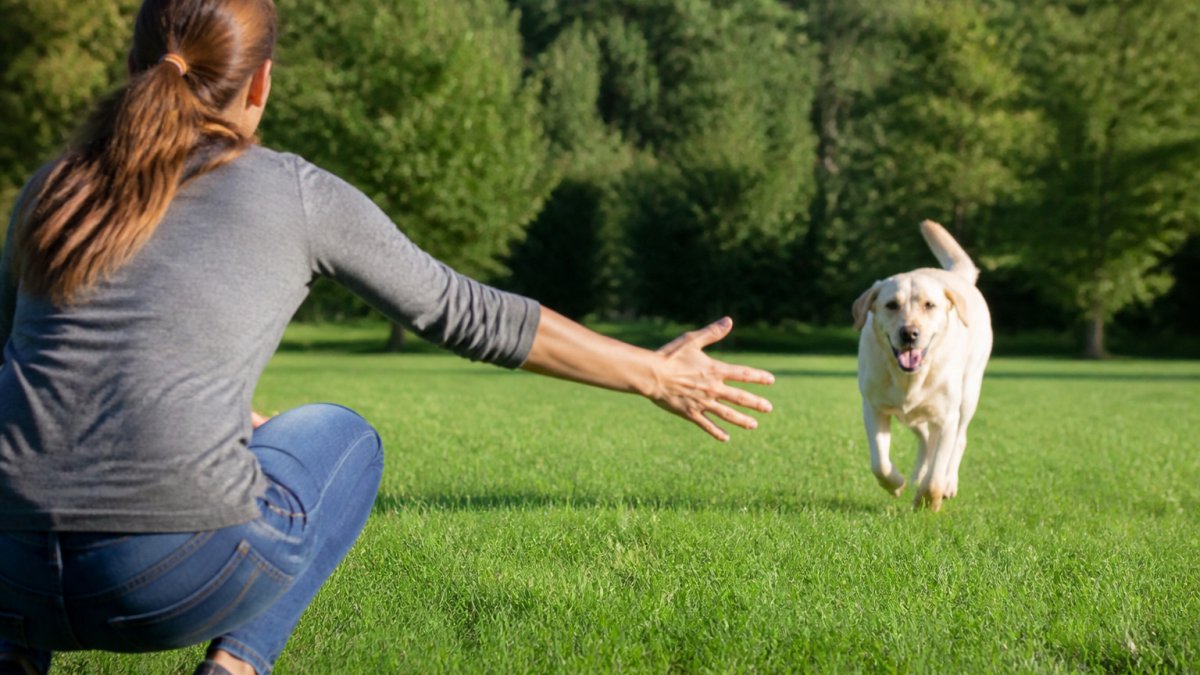
Start in a quiet room with no other people, pets, or noise. This low-distraction environment lets your dog focus entirely on you and the reward. Say your recall word once in a cheerful voice, then back away a step or two.
When your dog comes to you, reward instantly. Keep sessions short, around two to three minutes, and end on a win. Repeat several times a day.
Here is the basic indoor sequence:
- Stand a few feet from your dog.
- Say the recall word once, cheerfully.
- Back away to encourage movement toward you.
- Reward the moment your dog reaches you.
- Repeat five to ten times, then stop.
Practice indoors until your dog comes on the first cue nearly every time. That is your green light to add small distractions, like a toy on the floor or another person in the room.
Step 2: Reward Every Return With High-Value Treats and Play
Reward every single return at first, and make the reward worth the trip. A high-value treat, a favorite toy, or excited verbal praise all work. The reward must beat whatever your dog is leaving behind.
What most guides miss is that the reward is not a bribe. It is payment for a job well done, delivered fast. Timing is everything: reward within a second or two of your dog reaching you, or the lesson gets muddled.
Mix your rewards to keep motivation high:
- Food treats: small, smelly, and easy to swallow
- Toy play: a quick game of tug or fetch
- Verbal praise: a happy, high-pitched "yes!"
- Physical attention: a scratch behind the ears
Never call your dog to punish it. If you call your dog to clip nails or end the fun at the park, recall starts to feel like bad news. Call, reward, then release your dog back to play.
How to Train a Dog Recall With a Long Line
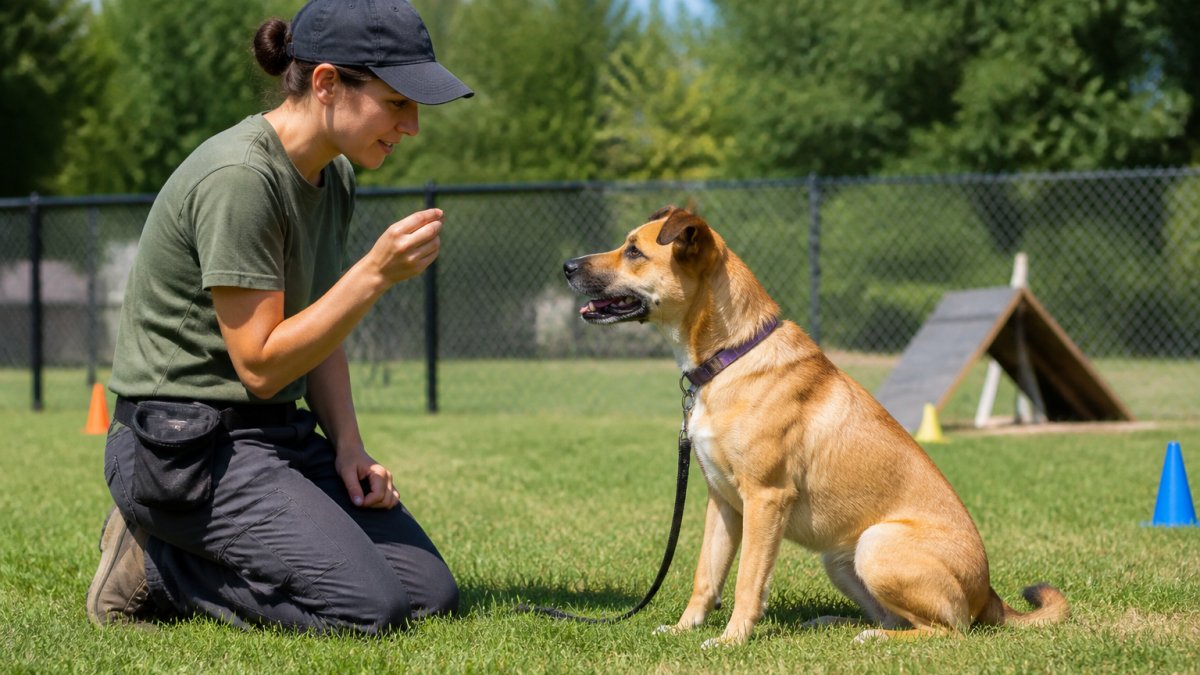
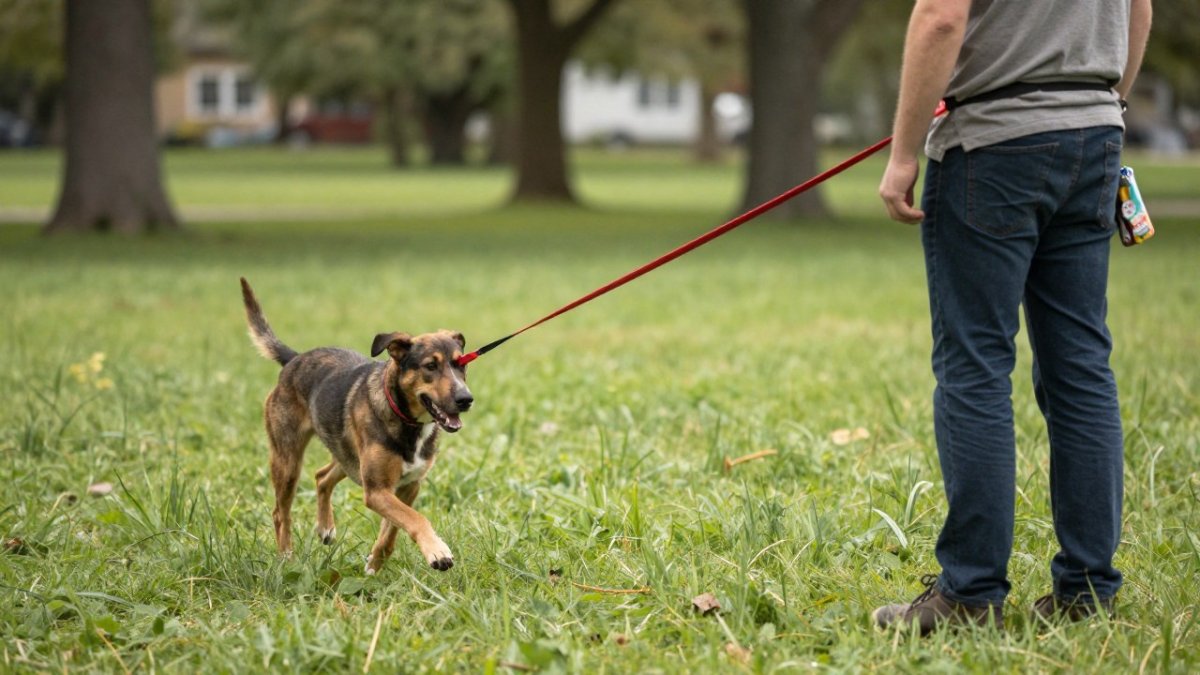
A long line is a lightweight training leash, usually 15 to 30 feet, that lets your dog practice distance while you keep physical control. It is the bridge between indoor practice and true off-leash reliability, and it is the single most important piece of safety equipment in recall training. Used well, it prevents the exact failure that ruins recall: a dog who learns he can ignore the cue and self-reward by running off.
Choosing and Setting Up the Line
Line material matters more than most owners realize. A flat nylon or biothane line is easy to see and less likely to slice through grass and hands than a thin cord. Biothane resists water and dirt and stays supple in cold weather; nylon is cheaper but holds moisture and can stiffen. Width matters too: a 3/8-inch to 1/2-inch flat line is a common choice for medium and large dogs because it is easier to grip and less likely to burn your palm than a thin rope.
Attach the long line to a harness, not the collar, to protect your dog's neck if he hits the end at speed. A back-clip harness spreads the load across the chest. Check the hardware before every session: a cheap snap hook can bend open under a hard lunge, so inspect the clip and the stitching where the line meets the handle.
Handling the Line Safely
Never wrap the line around your hand, wrist, or fingers. A loop around a body part turns a sudden lunge into a tourniquet or a fracture. Instead, hold the line in loose folds and let it pay out through your fingers, or stand on the end for an emergency stop in a fenced area.
Keep the line clear of your legs and your dog's legs. A line that wraps a hind leg mid-run can trip a dog at full speed. Coil the slack as your dog returns rather than letting it pile on the ground where he can step in it.
Watch out: a long line in an unfenced area near roads, bikes, or other dogs is a control tool, not a guarantee, and a hard lunge can still pull the line from a distracted handler's grip.
Where to Practice First
Start in a fenced area, such as a backyard or an empty tennis court, so a dropped line or a missed grab is not a disaster. Practice the mechanics of paying out line, calling, and coiling the slack before you add real-world distractions. Once your dog is reliable at the current distance in the fenced space, move to open ground with the line still attached.
For a deeper walkthrough of building off-leash reliability, see our guide on teaching dogs off-leash reliability.
Adding Distance Without Losing Control
Increase distance in small steps. Start at five feet, then ten, then fifteen. Only add more distance when your dog comes promptly at the current range. If your dog fails twice in a row, shorten the distance and rebuild the win. A useful rule of thumb: add no more than about five feet of new distance at a time, and only after your dog has hit the current distance on the first cue in at least eight of ten tries.
Use the line to prevent rehearsal of the wrong behavior, not to reel your dog in. If your dog ignores the cue, do not yank the line. Instead, wait a beat, then use gentle line pressure or a step backward to guide him toward you, and reward the moment he turns. The line exists so the cue never becomes optional; it is not a correction device.
Common Long-Line Mistakes
- Holding the line taut: a tight line signals restraint and can make a dog pull against it. Keep slack in the line during the recall.
- Using a retractable leash as a long line: retractable leashes lock and recoil unpredictably and are a poor substitute for a fixed-length training line.
- Skipping the harness: collar attachment on a long line risks neck injury on a hard stop.
- Practicing only in the same spot: vary locations once the mechanics are solid, or your dog learns the setting rather than the cue.
Dog Recall Training With Distractions: A Staged Progression Plan
Dog recall training with distractions follows a clear ladder. Each stage adds one new challenge, and you only climb when your dog is solid at the current rung.
- Indoors, no distractions: quiet room, single cue.
- Indoors, mild distractions: a toy or another person present.
- Backyard, low distractions: familiar space, few sights and sounds.
- Long line outdoors: open space with mild real-world activity.
- Controlled distractions: a helper with a leashed dog at a distance.
- Real-world proofing: parks, trails, and unexpected triggers.
For handlers ready to push further, our advanced off-leash training programs cover the next level of precision and reliability.
Measurable Progression Criteria for Each Stage
Do not guess when to move up. Use a simple success rate as your gate. Aim for your dog coming on the first cue in at least eight out of ten tries before you add difficulty. Track response latency too: a fast, eager return beats a slow, reluctant one.
| Stage | Setting | Success Gate Before Advancing |
|---|---|---|
| 1 | Indoors, quiet | 9 of 10 first-cue returns |
| 2 | Indoors, mild distraction | 8 of 10 first-cue returns |
| 3 | Backyard, low distraction | 8 of 10 first-cue returns |
| 4 | Long line outdoors | 8 of 10 with fast response |
| 5 | Helper and leashed dog | 7 of 10 under controlled setup |
| 6 | Real-world proofing | 8 of 10 across varied locations |
How Long Does It Take a Dog to Learn Recall?
The timeline depends on your dog's age, breed drive, and how often you practice.
Skipping stages can build a dog who comes indoors but struggles outdoors, so slow, steady progression is the safer approach.
If you want structured help hitting your timeline, our training packages lay out a clear path from first cue to off-leash confidence.
Troubleshooting Recall by Cause: Why Your Dog Doesn't Come
When recall breaks down, diagnose the cause before you react. Most failures trace back to one of a few root problems, and each has a different fix.
- Too much distraction: shorten the distance and lower the difficulty.
- Weak reward: upgrade to a higher-value treat or a favorite toy.
- Poisoned cue: your dog learned that "come" sometimes means "fun ends." Rebuild trust with rewards only.
- Practice too fast: go back a stage and rebuild the win.
- Fear or anxiety: a nervous dog may shut down. Address the underlying stress first.
A common mistake is repeating the cue over and over. Say it once, then wait or gently encourage. Repetition teaches your dog that the word is optional.
Emergency Recall and Safety Rules Every Owner Should Know
Every dog should have an emergency recall: a separate cue reserved for genuine danger and never used for anything else. The everyday recall is your working cue, used dozens of times a day and rewarded with a normal treat. The emergency cue is the fire alarm: rare, serious, and always paid with a jackpot reward. Keeping the two separate is what gives the emergency cue its power, because it never predicts anything except an unusually good payout.
How to Condition a Separate Emergency Cue
Pick a cue you will not use by accident: a whistle blast, a specific word you never say otherwise, or a distinct sound. The most common pattern is a whistle because it carries farther than a voice and stays consistent in tone across handlers and weather.
Condition the cue in short, high-value sessions:
- Charge the cue indoors. Give the cue once, then immediately deliver a jackpot: several small pieces of the best food you have, fed one after another, or a brief game with a favorite toy. Do not ask for a behavior first; the cue itself predicts the reward.
- Repeat in low-distraction settings. Five to ten repetitions per session, a few sessions a day, until your dog visibly perks up and turns toward you the instant he hears the cue.
- Add distance and mild distraction. Practice from another room, then the backyard, then a quiet outdoor space. Keep the jackpot every single time at this stage.
- Proof in controlled real-world settings. Use a helper or a leashed decoy dog at a distance, and only fire the cue when you can guarantee the reward follows.
A common pattern is to reserve the emergency cue for no more than a handful of real uses per year, plus monthly maintenance drills. If you use it often, it stops being special and starts competing with your everyday cue.
Proofing and Maintenance
Practice the emergency cue monthly in a low-stakes setting so the response stays sharp. Treat it like a fire drill: you rehearse it so that when you need it, the behavior is automatic. Keep a small stash of the jackpot food in a sealed bag in your car, training pouch, and by the door so the reward is always within reach.
Watch out: never test the emergency cue in a genuinely dangerous situation before it is proven in controlled setups, and never use it as a recall cue for everyday calls, or you will dilute the one signal you most need to stay distinct.
Safety Rules That Protect the Cue
- Keep your dog leashed until recall is proven in that specific setting, not just in general.
- Carry high-value treats on every walk, even the short ones.
- Never punish a dog that finally comes to you, even after a long delay.
- Use a long line in any unfenced area during training.
- Do not repeat the emergency cue; fire it once and wait or move to guide your dog.
- Retire a cue that has been poisoned by punishment or repeated failure, and condition a fresh one.
The American Kennel Club's training resources offer additional guidance on building reliable responses. Treat emergency recall like a fire drill: rare, serious, and always rewarded.
Recall for Puppies, Adolescent Dogs, and Adult Rescues
Age changes how you teach recall, but the core method stays the same. Puppies are sponges who learn fast but have short attention spans. Keep sessions brief and playful, and lean on our puppy obedience training tips to build a strong foundation early.
Adolescent dogs test boundaries, so expect setbacks and stay consistent. Adult rescues may carry old habits or anxiety, which means slower, trust-building steps. Our guide to professional training for rescue dogs covers the specific approach these dogs need.
Match your expectations to the dog in front of you, and reward every return along the way.
Training a reliable recall takes patience, consistency, and the right progression, and it is one of the most rewarding skills you can build with your dog. If you want expert guidance to get there faster, Voca Springs Dog Training offers obedience and behavior modification programs built around your dog's needs, from foundational manners to off-leash reliability. Our team focuses on strengthening the owner-dog bond while delivering dependable results. Get started with Voca Springs Dog Training and give your dog the freedom that comes with a rock-solid recall.
Frequently Asked Questions
How long does it take a dog to learn recall?
Most dogs show a basic indoor response within two to four weeks of short daily sessions, but reliable off-leash recall takes months of proofing across different places and distraction levels. Progress depends on the dog's age, breed drive, and how consistently the handler rewards every return. Expect to revisit the cue in new environments rather than treating training as finished. Dogs that practice in five-minute sessions several times a week generally advance faster than those with one long weekly session.
How do you train a dog to come when called around distractions?
Build the behavior in a low-distraction setting first, then add one distraction at a time while keeping distance short and rewards high. Start with a long line in a quiet park, then introduce a helper, another dog, or wildlife scent at a distance your dog can still succeed. Reward every return, release the dog back to the distraction often, and only increase difficulty when your dog responds on the first cue at the current level. Rushing this stage is the most common reason recall fails outdoors.
Can you teach an adult dog or rescue reliable recall?
Yes. Adult dogs and rescues can learn recall, though they often need a longer foundation phase and a slower distraction progression than puppies. Start indoors with high-value food treats, keep sessions short, and avoid calling your dog for anything unpleasant such as nail trims or bath time during the training period. Rescues benefit from a predictable routine and a handler who rewards generously. A structured plan with measurable stages works better than repeating the cue and hoping for improvement.
What words should I use for a dog recall cue?
Pick one short, distinctive word such as come, here, or front, and use it only for recall so it keeps its value. Avoid repeating your dog's name as the cue, since the name gets used constantly and loses meaning. Many handlers add a separate emergency word or a whistle for safety situations. Say the cue once in a cheerful voice, then reward every correct response. Consistency across everyone in the household matters as much as the word you choose.