 how-to
Professional Dog Training for Rescue Dogs: A Complete Guide
Last Updated: October 31, 2026
Quick Summary
Professional dog training for rescue dogs starts by building a plan around each dog's history instead of a one-size script, because rescue dogs are not blank slates. Training begins with a safe space, a predictable routine, and reward-based methods that build trust before formal cues.
- Keep the first 24 hours boring: skip visitors, pet store detours, and introductions for 48 hours.
- If your dog is still shut down at week six, bring in professional help rather than wait it out.
- Keep training sessions to two to five minutes, three to five times a day, ending while the dog is winning.
- Re-sort the dog into a track at day 30, since masked reactivity often appears as fear fades.
- Call your vet for sudden behavior change, night waking, or growling when touched in a specific spot.
Table of Contents
- Why Professional Dog Training for Rescue Dogs Works Differently
- How to Train an Adopted Dog: The First Day and First Week
- How Long Does It Take a Rescue Dog to Adjust?
- Common Rescue Dog Behavior Problems and What They Signal
- Building Trust With Reward-Based Training and a Predictable Routine
- House Training, Supervision, and Preventing Accidents and Chewing
- Teaching Foundational Cues: Name Response, Sit, Recall, and Settling
- Private Dog Training for Rescue Dogs: Formats, Cost, and Credentials
- A Measurable 30-to-90-Day Training Plan and When to Call a Vet
- Booking Your First Rescue Dog Training Session
- Frequently Asked Questions
Why Professional Dog Training for Rescue Dogs Works Differently
Professional dog training for rescue dogs starts with a different question than training a puppy from a breeder. You are not shaping a blank slate. You are helping a dog unlearn survival habits and learn that people are safe.
That gap matters. A rescue dog may have spent weeks in a shelter kennel, bounced between homes, or lived on the street, and standard puppy advice often lands flat.
At Voca Springs Dog Training, we build plans around each dog's history instead of a one-size script. Below, we break down the first week, the adjustment timeline, the behavior problems that worry owners most, and how to choose real professional help.
What Rescue Dogs Bring Through the Door
Rescue dogs arrive with a history you can only partly see. Shelter staff may know some of it, foster homes more, but nobody knows all of it.
That history shows up as behavior:
- Fear of hands, brooms, or raised voices
- Guarding food, toys, or a favorite person
- Reactivity on leash: barking, lunging, pulling
- House soiling in a new space
- Destructive chewing when left alone
- Shutting down or hiding for days
None of this is dominance. It is usually stress, uncertainty, or a learned habit that once kept the dog safe. Reading fear as stubbornness sets training back weeks.
How to Train an Adopted Dog: The First Day and First Week
The first 24 hours should be boring on purpose. Skip the party, the park, and the parade of visiting friends. A quiet house teaches your new dog that nothing bad happens here.
Here is the order we recommend:
- Set up the safe space first. A crate or pen in a low-traffic room, with a bed, water, and a chew toy.
- Go straight home. No pet store detour, no meet-and-greet.
- Let the dog explore one room. Keep the leash on for the first few hours.
- Offer food and water, then step back. Some dogs eat immediately, some wait until dark.
- Start a potty schedule right away. Out every hour or two, plus after meals and naps.
- Skip introductions for 48 hours. Other pets and children can wait.
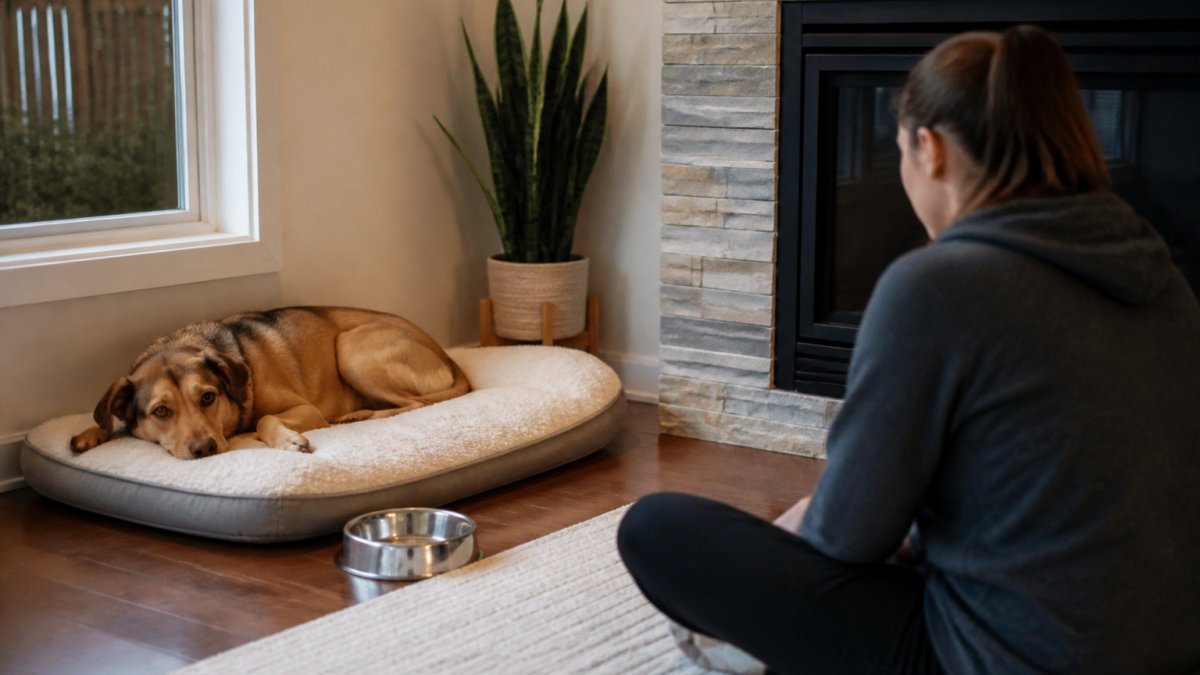
Setting Up a Safe Space Before Your Dog Comes Home
A safe space is a small, enclosed area where the dog can retreat and nobody follows. It is not a punishment zone. The door stays open when possible, and treats appear there without warning.
Stock it before arrival:
- Crate or exercise pen, sized so the dog can stand and turn
- Washable bed and a spare blanket
- Water bowl that clips to the side
- Long-lasting chew, safe for the dog's size
- Baby gate for the doorway
Watch out: Don't let guests crowd the crate in week one. A dog that feels trapped in its only safe spot learns the crate is a trap.
How Long Does It Take a Rescue Dog to Adjust?
Rescue dogs settle at their own pace. Some take a few weeks to adjust to a routine, while others need several months to show their real personality.
Signs of progress look small at first:
- Eating normal meals without hiding
- Sleeping with eyes closed and body relaxed
- Coming out of the safe space on its own
- Taking treats from your hand
- Following you room to room
If your dog is still shut down at week six, that is your signal to bring in professional help rather than wait it out.
Common Rescue Dog Behavior Problems and What They Signal
Rescue dog behavior problems often have different underlying causes, and identifying the cause matters more than the label.
| Behavior | What It Usually Signals | First Move |
|---|---|---|
| Hiding or freezing | Fear, overwhelm | Reduce space, add distance |
| Food or toy guarding | Insecurity about resources | Feed alone, trade up with treats |
| Leash barking and lunging | Reactivity, often fear-based | Increase distance from triggers |
| House soiling | Incomplete house training or stress | Restart a potty schedule |
| Destructive chewing | Boredom, teething, or separation stress | Supervision plus appropriate chews |
| Clinging or panic when alone | Separation-related distress | Build short absences gradually |
Building Trust With Reward-Based Training and a Predictable Routine
Trust comes from predictability: same wake-up time, meal times, potty trips, and short training sessions. A dog that can predict the day stops bracing for surprises.
Reward-based training, also called force-free or positive reinforcement training, means you mark and pay the behavior you want rather than correcting what you don't. Punishment raises fear in a dog that is already unsure, and fear drives most problem behavior.
Keep sessions short:
- Two to five minutes, three to five times a day
- End while the dog is still winning
- Use food your dog actually values
- Train before meals, not after
For a deeper walkthrough on building that bond in the early weeks, see our guide on how to build a bond with a rescue dog.
House Training, Supervision, and Preventing Accidents and Chewing
House training a rescue dog means starting from zero, even if the shelter said the dog was trained. New spaces reset habits.
The schedule that works:
- Out first thing in the morning
- Out after every meal, nap, and play session
- Out every hour or two during the day
- Out right before bed
- Crate or tether the dog when you cannot watch it
Supervision is the other half. A dog that is loose and unwatched in a new house will find something to chew, usually something you like.
Chewing is normal; destructive chewing is usually boredom, stress, or too much freedom too soon. Offer better options and rotate them so they stay interesting. If chewing is a daily battle, our article on fixing destructive chewing in dogs walks through the full plan.
Watch out: Don't scold a dog for an accident you find hours later. The dog cannot connect the correction to the act, and you only teach it to hide from you.
Teaching Foundational Cues: Name Response, Sit, Recall, and Settling
Four cues carry most of daily life with a rescue dog. Teach them in this order, and keep every session upbeat.
- Name response. Say the name once, then pay the dog for looking at you. Ten reps, several times a day.
- Sit. Lure with a treat over the nose, mark the moment the rear hits the floor, pay.
- Recall. Start indoors at three feet. Say the cue once, then reward generously for coming. Never call the dog to something it dislikes.
- Settling. Reward the dog for lying down calmly on a mat. Build duration a few seconds at a time.
Add leash and door manners once those four are solid. A dog that waits at the door and walks without pulling is a dog you can take anywhere.
Consistency beats intensity. Five short sessions a day will outrun one long weekend session every time.
Private Dog Training for Rescue Dogs: Formats, Cost, and Credentials
Private dog training for rescue dogs comes in four common formats, and the right one depends on the behavior, the dog's stress threshold, and how much coaching you need. Most owners overpay for the wrong format because nobody explained the trade-offs.
The Four Formats and What Each Is Actually For
In-home private sessions. A trainer comes to your house and works in the rooms and on the streets where the behavior happens. Best for house soiling, door manners, resource guarding, and leash reactivity in the dog's own neighborhood. Session length and frequency vary by provider and by the dog's needs. Expect travel time to affect cost.
Private sessions at a training facility. Facility-based sessions often avoid travel time, and the trainer can control the environment. Best for foundational cues, settling on a mat, and controlled exposure to other dogs at a distance. The weakness is generalization: a dog that is perfect at the facility may fall apart on your sidewalk.
Group classes. Group classes are often lower cost per session and suit dogs already comfortable around other dogs and people. A rescue dog that is still shutting down, freezing, or lunging is not a group-class candidate yet; a reactive dog in a room of other dogs is a flooding exercise, not training. Ask whether the class separates reactive dogs with visual barriers and whether the instructor caps enrollment.
Board-and-train and day-training programs. The dog stays with the trainer for two to four weeks or attends day training several times a week. Convenient, but typically a higher-cost format. The critical question is what you learn, not what the dog learns: ask how many transfer sessions are included, whether you get video of every session, and what happens when the dog comes home and the old routine returns. A dog that learned a behavior in a kennel still has to relearn it in your kitchen.
What Drives the Price
Pricing depends on several factors, and current prices and quotes are available on our website. Factors that influence cost include:
- Format. Group classes sit at the low end; in-home private and board-and-train at the high end.
- Session count and package size. Package pricing may differ from per-visit pricing.
- Travel distance. In-home providers commonly add a trip fee beyond a set radius.
- Behavior severity. Reactivity, guarding, and separation-related distress take more sessions and planning than basic manners.
- Credentials and demand. Certified trainers and veterinary behaviorists charge more, with longer waitlists.
- Assessment fees. Many providers charge a separate intake or behavior-assessment fee before the first session.
Ask for a written quote that lists the number of sessions, the length of each session, whether the assessment is included, any travel fee, and the cancellation policy. Visit our website for current pricing or to request a quote.
How to Vet a Trainer Before You Book
Dog training credentials are not standardized in the way veterinary medicine is, so it helps to check rather than assume. Consider asking these questions:
- Ask what method they use and whether they use aversive tools such as shock, prong, or choke collars
- Ask how they handle fear, reactivity, and resource guarding, and ask for a specific example
- Ask how many rescue dogs they have worked with and what histories they see most often
- Ask for a written plan with goals, timelines, and how progress will be measured
- Ask what happens if progress stalls after four sessions
- Ask how much of the session is coaching you versus handling the dog
- Confirm they will work in your home and neighborhood if that matters to you
- Ask whether they carry liability insurance
- Ask for their referral boundaries: when do they send a case to a veterinarian or veterinary behaviorist
- Read reviews for how they talk about dogs, not just for before-and-after results
The Certification Council for Professional Dog Trainers maintains a searchable directory of certified trainers, which is a reasonable starting filter. The American Veterinary Society of Animal Behavior publishes position statements on humane training that are worth reading before you hire anyone. A trainer who cannot explain why those statements matter is a trainer to skip.
If cost is your main worry, our breakdown of private dog training session cost factors covers what drives the number up or down. You can also review common questions on our training FAQ page before you commit.
A Measurable 30-to-90-Day Training Plan and When to Call a Vet
A training plan without measurements is just hope. The plan below outlines a general structure that you can apply with a qualified trainer. The key is that it branches by the dog's history instead of treating every rescue dog the same.
Pick Your Track First
Before day one, sort the dog into one of three tracks based on what you actually see in the first week:
- Shutdown or fearful track. The dog hides, freezes, won't eat from your hand, or flinches at movement. Priority is decompression and distance, not cues. Delay formal training until the dog takes food from your hand and leaves the safe space on its own.
- Over-aroused or reactive track. The dog barks, lunges, pulls, or guards. Priority is distance from triggers and management that prevents rehearsal. Cue training runs in parallel at low intensity.
- Undersocialized but stable track. The dog is friendly, eats normally, and explores, but has gaps in house training, leash manners, or settling. Priority is foundational cues and routine.
A dog can move between tracks. A shutdown dog that relaxes in week three often reveals reactivity that was masked by fear, so re-sort at day 30.
Days 1-30: Settle and Baseline
No new environments. The goal is a stable routine and a set of numbers you can compare against later. Track these weekly:
- Potty accidents per week. Count them, don't estimate.
- Reactive episodes per walk. Define an episode as barking, lunging, or freezing at a trigger, and note the distance.
- Successful name responses per session. Ten offered, how many landed?
- Recovery time after a startle. Seconds or minutes until the dog takes a treat and relaxes.
- Meals eaten normally. Out of 14 weekly meals, how many were finished without hiding?
Write the numbers down. Tracking for two weeks often shows whether behavior is improving faster or slower than it feels.
Days 31-60: Build Skills Under Mild Distraction
Add sit, recall, and settling on a mat. The threshold for adding difficulty is five clean repetitions in a row at the current level. If the dog fails two reps in a row, you added difficulty too fast; drop back one step.
- Recall. Start indoors at three feet, then six, then across a room. Add one mild distraction (a toy on the floor, a person standing still) only after ten clean reps at the current distance.
- Settling. Build duration a few seconds at a time; a realistic day-60 target is two to three minutes on a mat while you sit nearby.
- Leash manners. Measure trigger distance, not just pulling. If the dog can walk past a trigger at 30 feet without reacting, that is your baseline; shrink it gradually rather than eliminating it overnight.
Days 61-90: Generalize and Re-Measure
Practice in the front yard, then the sidewalk, then a quiet park at a low-traffic hour. Re-measure the same numbers from month one and compare:
- Accidents per week should be trending toward zero.
- Reactive episodes per walk should be fewer, or happening at a shorter distance, or recovering faster.
- Name response should hold at eight or nine out of ten in a mildly distracting environment.
If the numbers have not moved in 30 days of consistent work, that is the signal to bring in a professional or a veterinarian, not to push harder.
When to Call a Vet Before You Train
Call your veterinarian if you see any of these:
- Sudden behavior change in an adult dog
- House soiling in a previously reliable dog
- Night waking, pacing, or disorientation
- Growling when touched in a specific spot
- Loss of appetite paired with behavior changes
- New fear of familiar people or places
Pain and medical issues can look exactly like training problems. A dog with dental pain may guard food; a dog with hip pain may refuse to sit; a dog with thyroid or cognitive changes may seem suddenly anxious. Training a medical problem makes the dog worse and wastes your money. A veterinary behaviorist is the right call when fear, anxiety, or aggression is severe, when there is a bite history, or when training alone has not moved the numbers in 30 days.
Booking Your First Rescue Dog Training Session
The hardest part of rescue dog training is not the dog. It is deciding to ask for help before week six turns into month six.
If your dog is anxious, reactive, or simply not settling, we can build a plan around its history. Voca Springs Dog Training specializes in obedience and behavior modification, with a focus on the owner-dog bond. Our local service area covers Caddo and Caney, Oklahoma.
You can visit our website to see the formats available and pick the one that fits your dog's needs.
Frequently Asked Questions
How soon should you start training a rescue dog?
Start teaching basic cues like name response and sit within the first few days, but keep sessions to two or three minutes and low-key. The first week is about decompression, not performance. Formal professional dog training for rescue dogs usually works best once the dog has had roughly a week to settle and you have observed its behavior patterns. If fear, reactivity, or guarding shows up early, call a trainer sooner rather than waiting.
How do you choose a trainer for a rescue dog?
Look for recognized credentials, or a veterinary behaviorist for medical-behavior cases. Ask what methods they use, and walk away from anyone relying on fear, choke chains, or shock. A good trainer asks about your dog's history and offers a clear plan. When comparing private dog training for rescue dogs, ask what settings a provider works in.
Can a professional trainer help a rescue dog with fear or anxiety?
Yes, reward-based training and behavior modification can reduce fear responses over time. A trainer can build a plan around your dog's specific triggers, using gradual exposure and positive reinforcement. Severe cases, especially with sudden-onset anxiety or aggression, should be checked by a veterinarian first to rule out pain or medical causes. A qualified behavior consultant can then coordinate with your vet on a plan.
Can older rescue dogs still be trained?
Yes. Older dogs learn new cues reliably, though progress may be slower and physical limitations matter. Keep sessions short, use soft treats, and avoid high-impact activities if joints are a concern. Senior rescue dogs often arrive with long-standing habits, so consistency and a predictable routine count more than speed. A trainer can adapt the plan to your dog's age and health.
Start with one small step this week: pick a single behavior, track it for seven days, and bring those notes to your first session. Get started with Voca Springs Dog Training and give your rescue dog a plan built for its history, not a generic script.