 how-to
How to Teach a Dog to Settle on a Mat, Step by Step
Last Updated: November 5, 2026
Quick Summary
To teach a dog to settle on a mat, first build a positive association by tossing treats onto the mat, then reward each step toward a lie-down. Once the dog lies down reliably, add duration in stages, rewarding on the mat and releasing clearly. Add a verbal cue last, and practice in new places.
- Keep the same mat in one quiet spot so the cue stays consistent.
- Keep first sessions to about two to five minutes and stop while the dog still wants more.
- Reward each small step, from sniffing the mat to lying fully down.
- Advance duration only after three successes in four reps with relaxed body language.
- Add a verbal cue just before the dog moves to the mat, then practice in new rooms.
Table of Contents
- What Settling on a Mat Means and Why It Helps
- Choosing the Right Mat and a Designated Settle Spot
- Introducing the Mat and Building a Positive Association
- Teaching the Lie-Down and Rewarding Each Approach
- Building Duration and Relaxation in Stages
- Adding a Verbal Cue and Practicing Real-World Settling
- Using Mat Training for Reactive and Anxious Dogs
- Troubleshooting Common Mat Training Problems
- Start Your Settle Training Plan at Voca Springs
- Frequently Asked Questions
What Settling on a Mat Means and Why It Helps
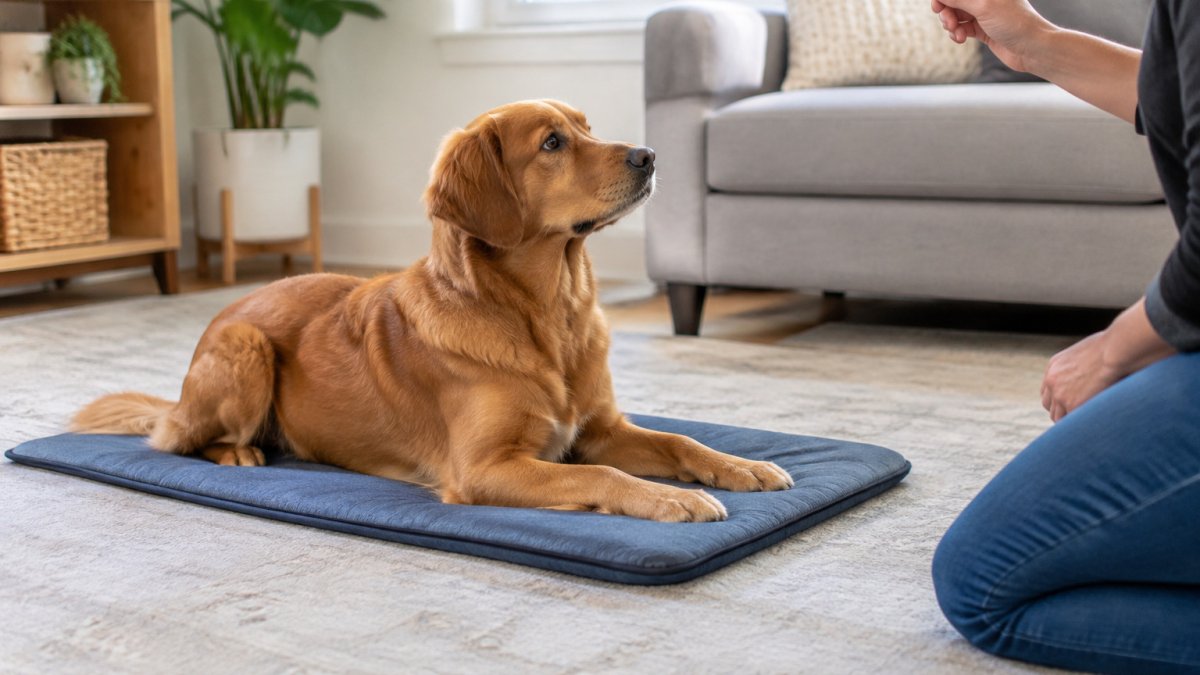
Settle training is a calm, relaxed behavior where your dog learns to settle on a mat, lying down on a designated spot and staying there until you release it. It is not the same as a forced stay. The dog chooses to rest, and that choice is what makes this skill useful.
Many dog owners find that teaching a dog to settle on a mat gives it a clear "home base." That spot can help during dinner, visitors, or times when the household is busy. Dogs learn that the mat means calm, quiet time.
Settle training also teaches impulse control. A dog that can settle is easier to manage in new places, around doorbells, and during meals.
Choosing the Right Mat and a Designated Settle Spot
Pick a mat that is large enough for your dog to lie down fully and turn around. A flat, firm mat with a non-slip bottom works well for most homes. Many owners choose a portable mat so they can take it along on trips.
Choose one spot in the house and keep the mat there. Consistency helps your dog learn where the skill applies. A corner of the living room, away from the front door, is a common choice.
Keep these details in mind:
- Pick a quiet area with some foot traffic but not the busiest path
- Use the same mat every session so the cue stays consistent
- Make sure your dog has easy access to water nearby
- Avoid placing the mat near food bowls at first
A common mistake is choosing a spot that is too exciting. Start where your dog already feels relaxed, then move the mat later.
Introducing the Mat and Building a Positive Association
Place the mat on the floor and let your dog sniff it. Toss a few treats onto the mat so your dog steps on it by choice. Do not pull or lure your dog hard onto it.
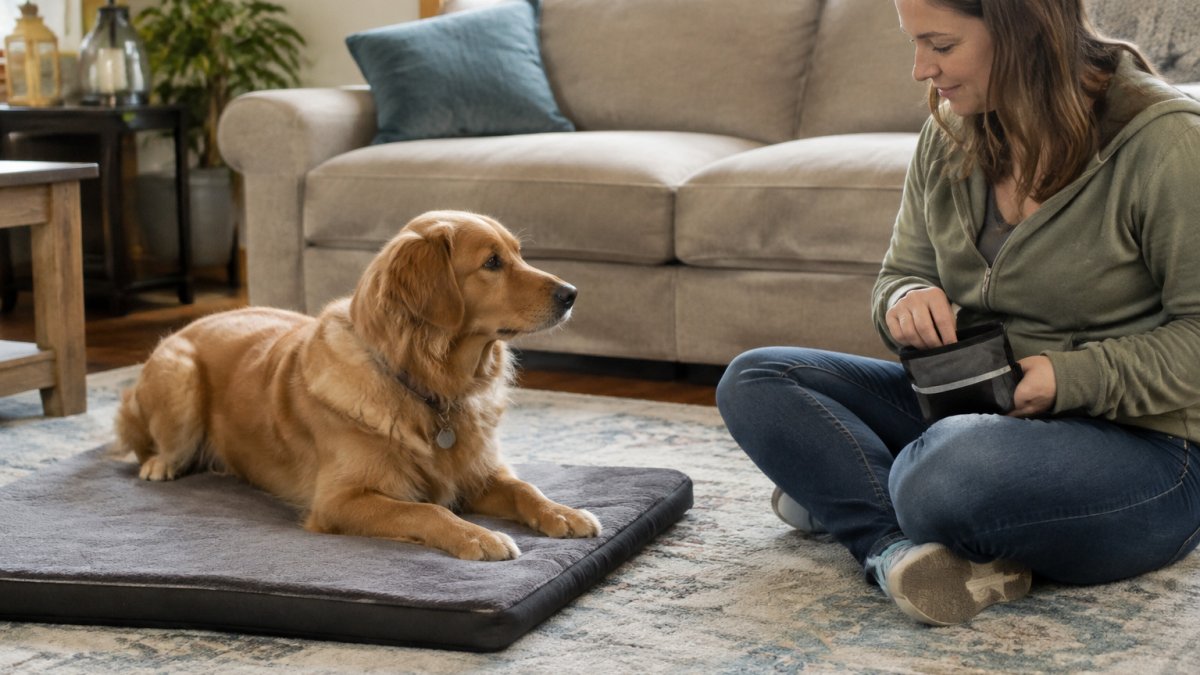
Keep sessions short, about two to five minutes. Stop while your dog still wants to play with the mat. This helps build a positive feeling about it.
Here is a simple first-day routine:
- Show the mat and say your chosen cue word once
- Toss a treat onto the mat
- When your dog steps on it, mark the moment with "yes" or a clicker
- Give a treat right away
- End the session on a happy note
Repeat this across several days. Your dog should start moving toward the mat on its own.
Teaching the Lie-Down and Rewarding Each Approach
Once your dog reliably steps onto the mat, reward it for lying down. Wait quietly for the body to lower. Mark the moment it lies down and deliver the treat on the mat.
Reward each small step: looking at the mat, approaching it, putting one paw on it, then all four paws. Many trainers call this shaping. It builds the behavior one piece at a time.
Common rewards include small, soft treats your dog loves. Save higher-value treats for harder steps. Some owners also use a favorite chew for longer settles.
Watch out: luring your dog into a down with food held at the nose often leads to a hunched, anxious posture. Wait for the dog to lower itself instead.
Building Duration and Relaxation in Stages
Duration work fails for one of two reasons: the handler adds time before the dog is actually relaxed, or the handler adds distance and distraction at the same time as time. Build one variable at a time, and use a simple rule to decide when to advance.
The progression rule most trainers use: advance only when your dog has succeeded at the current step in three out of four consecutive reps, with relaxed body language throughout. If the dog breaks position, gets up, or shows stress signals twice in a row, drop back one step for the rest of that session and end on an easy win.
Here is a staged plan with concrete thresholds. Treat the numbers as starting points, not targets to force.
- Stage 1, Duration only, handler close. Goal: 5 to 10 seconds of relaxed down with you standing or sitting within arm's reach. Reward every rep. Advance when three of four reps hit 10 seconds without the dog shifting or popping up.
- Stage 2, Duration plus small distance. Goal: 20 to 30 seconds while you take one or two steps away. Reward on the mat, then release. Advance when the dog holds 30 seconds with you two steps away in three of four reps.
- Stage 3, Duration plus handler movement. Goal: 1 to 2 minutes while you move around the room, open a cabinet, or sit on the couch. Reward intermittently, every 15 to 30 seconds at first, rather than continuously.
- Stage 4, Duration plus household noise. Goal: 3 to 5 minutes during normal activity such as cooking, a TV, or family walking through. Reward every 30 to 60 seconds, then fade to every 1 to 2 minutes.
- Stage 5, Duration plus mild distraction. Goal: 5 to 10 minutes with a doorbell sound on a phone, a dropped spoon, or a family member entering the room. Reward at the end of the rep and release.
Two mechanics matter more than the numbers. First, reward placement: deliver the treat on the mat, between the dog's front paws, so the dog learns the mat, not your hand, predicts reinforcement. Second, release timing: give a clear release word ("free" or "okay") and then toss a treat off the mat so the dog physically leaves. A dog that only ever gets released by you standing up will start predicting the release and popping up early.
Watch out: if you reward every rep at the same interval, many dogs start anticipating the treat and lift their heads or get up just before the reward arrives. Randomize the interval within the stage, sometimes 10 seconds, sometimes 25, so the dog learns that staying down, not watching your hand, is what pays.
Distinguishing relaxed settling from a forced stay is the part most guides skip. Genuine relaxation looks like a dog that shifts its weight onto one hip, lets its head rest or lower, softens its eyes, and breathes slowly. A dog that is merely holding still often shows a tucked tail, tense jaw, forward-leaning posture, or a fixed stare at the handler. If you see the second set of signals, you are building a stay, not a settle, shorten the rep and reward sooner.
Stress signals to watch for and respond to: yawning, lip licking, whale eye (showing the whites of the eyes), sudden scratching, and repeated position changes. One of these occasionally is normal; two or more in a single rep means the step is too hard. Drop back a stage, shorten the session to two or three minutes, and try again the next day.
Session length should scale with the dog, not the calendar. Puppies and adolescent dogs often do best with three to five short reps per session and two sessions a day. Adult dogs with prior training can usually handle five to eight reps. Senior dogs and dogs with mobility concerns may need a thicker mat, a shorter down duration, and a release before stiffness sets in, a 30-second settle that ends calmly beats a two-minute hold that ends with the dog struggling to rise.
Keep a simple log for the first two weeks: date, stage, longest successful rep, and any stress signals observed. Most owners find they advance faster when they track, because the log makes it obvious when a dog has actually met the three-of-four criterion rather than just had one good rep.
Adding a Verbal Cue and Practicing Real-World Settling
Once your dog settles reliably, add a cue such as "settle," "mat," or "go to bed." Say the cue just before your dog moves toward the mat. Then reward as usual.
Practice in different rooms, at different times of day, and with light distractions. Once settling is solid, you can explore which advanced commands every family dog should know to train next. Real life is noisier than training. Many dogs need extra practice around guests, cooking, and family movement.
Here is a practice tracker you can copy:
| Day | Duration Reached | Distractions Present | Notes |
|---|---|---|---|
| 1 | 5 seconds | None | Relaxed, took treat well |
| 2 | 15 seconds | Light noise | Got up once |
| 3 | 30 seconds | Family walking by | Stayed calm |
Keep notes like these to track progress.
Using Mat Training for Reactive and Anxious Dogs
Mat training can be one tool for helping a dog learn a calm place to go when something triggers it. Many owners use the mat as a safe spot during doorbells, visitors, or when other dogs pass by a window. The goal is to teach the dog to relax, not to force it to stay still.
For anxious dogs, go slower. Keep the mat in a quiet area and allow the dog to leave at any time. If your dog shows strong fear, anxiety-related behavior often needs more than mat work alone.
Reactive dogs benefit from distance. Start the mat in a room far from triggers, then move closer over time as your dog stays calm. For a fuller approach, see our step-by-step plan for reactive dogs.
Troubleshooting Common Mat Training Problems
Most mat-training setbacks fall into a small number of patterns, and each has a different fix. The mistake is treating every problem as "go slower." Sometimes the fix is slower; sometimes it is a different reward; sometimes it is a change in the environment; and sometimes it is a signal to stop and get qualified help.
Use the decision points below to diagnose before you adjust.
The dog will not approach the mat at all. Ask first whether the mat itself is aversive. A mat that has been used for a forced down, a nail trim, or a scolding will be avoided. Replace it with a fresh mat or a different texture and restart association from scratch. If the dog approaches but avoids stepping on, toss treats just past the mat so the dog crosses it, then reward. If the dog will not come near the area, move the mat to a room the dog already chooses to rest in.
The dog steps on, then immediately leaves. This is usually a rate-of-reward problem, not a duration problem. Reward faster, every one to two seconds at first, and reward on the mat. If the dog still leaves, the treats may be too low-value for the environment. Switch to a soft, smelly treat the dog only gets during mat work.
The dog gets up repeatedly during duration work. Check the three-of-four rule from the duration section: if the dog is failing two reps in a row, the step is too hard. Cut the duration in half and reward sooner. If the dog gets up specifically when you move, you have added distance before duration was solid, go back to Stage 1 for a session.
The dog becomes frustrated, barking, whining, pawing, or mugging your hand. Frustration usually means the dog cannot figure out what is being rewarded. Simplify: one criterion per rep. Reward for a down, then release; do not also ask for duration and quiet at the same time. If the dog is too excited to eat, the environment is over threshold, move to a quieter room, use a lower-value treat, or shorten the session to 60 seconds.
The dog is too excited to eat at all. This is a threshold signal, not a training problem. A dog that will not take food is usually too aroused or too stressed to learn. End the session, move away from the trigger, and try again at a lower intensity. Do not wait the dog out or withhold the reward to force compliance.
The dog settles fine at home but not in new places. This is a generalization gap, not a disobedience problem. Rebuild the behavior in the new location at Stage 1, short duration, high reward rate, handler close, even if the dog is at Stage 4 at home. Expect two to four sessions in a new environment before the dog matches its home performance.
The dog barks or whines while on the mat. Reward quiet moments, but do not wait so long that the dog escalates. Mark and reward the instant the dog pauses, then release. If barking continues across sessions, the dog is likely over-aroused by something in the environment, identify the trigger and add distance before continuing.
When to pause and seek help: stop mat training and consult a veterinarian or a qualified behavior professional if the dog shows panic (frantic escape attempts, heavy panting without heat, drooling), if the dog freezes and will not move, if the dog guards the mat aggressively, or if the behavior is getting worse across sessions rather than better. Mat training is not a substitute for treating underlying anxiety or pain, and a dog that is in pain will often refuse to lie down on cue.
Never use the mat as punishment. Sending a dog to the mat after a scolding, or using it as a time-out for unwanted behavior, teaches the dog that the mat predicts bad things. If you need a management spot for a dog that is over-aroused, use a different location and a different cue, and keep the mat reserved for calm, reinforced settling.
A final note on expectations: most family dogs need two to four weeks of short daily sessions to reach a reliable 5-minute settle at home, and another two to four weeks to generalize it to two or three new locations. A dog that is not progressing after three weeks of consistent, short sessions is usually being asked for too much, too fast, or has an underlying welfare issue that mat training alone will not solve.
Start Your Settle Training Plan at Voca Springs
If you want help building a settle plan for your dog, Voca Springs Dog Training works with owners in Caddo and Caney, Oklahoma, on obedience and behavior modification. Voca Springs Dog Training works with owners on obedience and behavior modification, including building strong owner-dog bonds.
Contact Voca Springs Dog Training directly to learn what training options are available and to confirm we serve your location before you book. Check our service area to see whether we cover your town. You can compare training packages to see what each one includes.
Frequently Asked Questions
How long does it take to train a dog to settle on a mat?
Most dogs learn the basic settle on a mat within one to three weeks of short daily sessions of five to ten minutes. Duration, calm behavior with distractions, and reliability in new places take longer, often several more weeks. Progress depends on the dog's age, history, and how consistently you practice. Move to the next stage only when your dog stays relaxed at the current level for several sessions in a row.
What is the difference between 'stay' and 'settle'?
A stay is a held position the dog maintains until released, usually with the handler working at a distance and expecting the dog to hold still. Settling is a relaxed, self-regulated state where the dog lies down on its mat and calms its body. Settling can be released or lie quietly without constant effort, while a stay is a more active command. Teaching settle on a mat first gives many dogs a calm foundation before formal stay work.
Can mat training help with dog leash reactivity?
Mat training is one general technique some owners use alongside other approaches when a dog is reactive around other dogs or people. Owners often use the mat at home, then at a distance from triggers, and reward calm behavior. It is not a complete fix on its own. Pair it with structured counter-conditioning and professional guidance when reactivity is severe, and consult a veterinarian about anxiety or pain contributing to the behavior.
Should I use a clicker for mat training?
A clicker can help if you want precise timing, because the click marks the exact moment your dog lies down or stays on the mat, followed by a treat. It is optional. Many dogs learn equally well with a verbal marker like 'yes' or simply quick treat delivery. Choose one marker, use it consistently, and make sure every family member uses it the same way so the dog learns clearly.